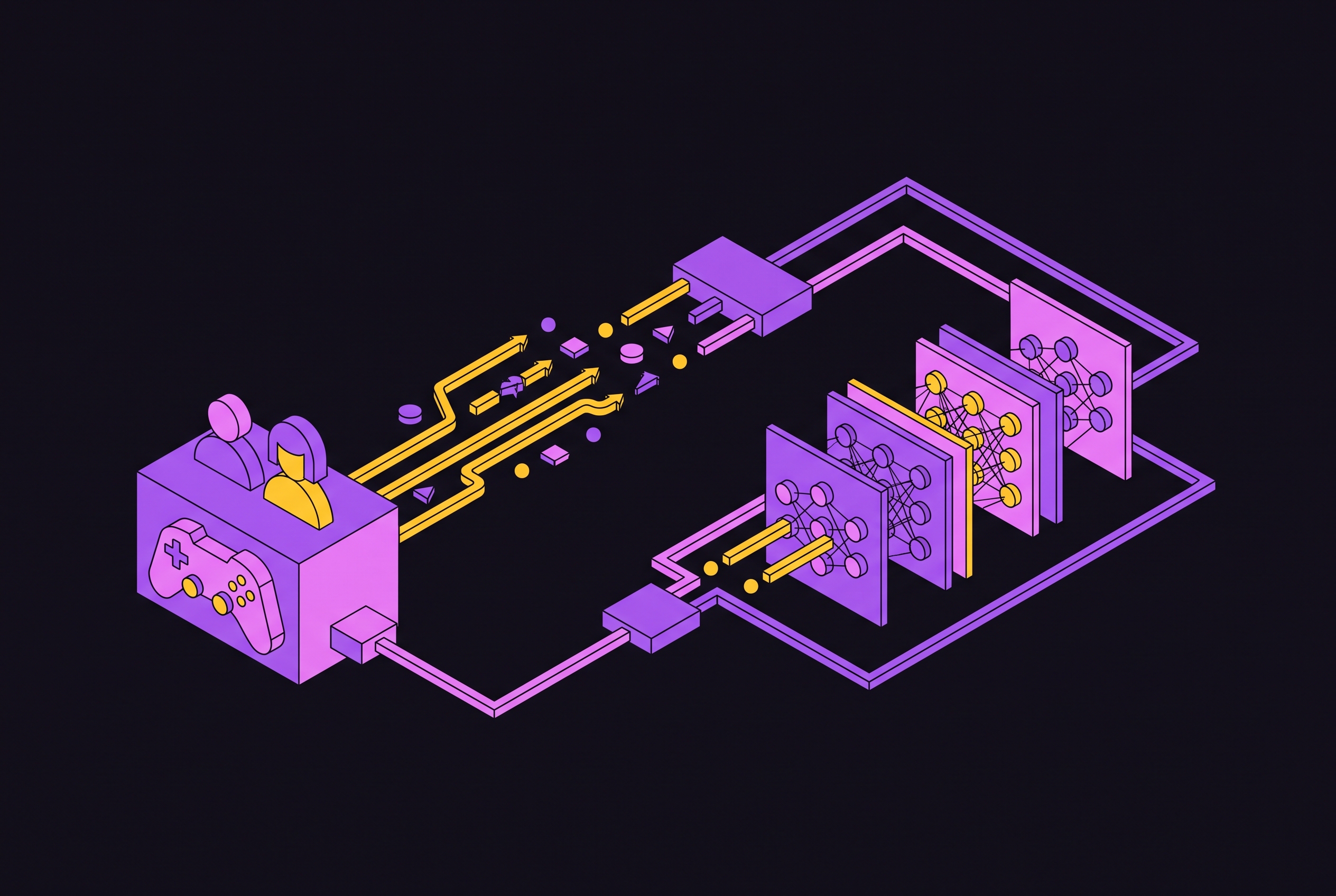
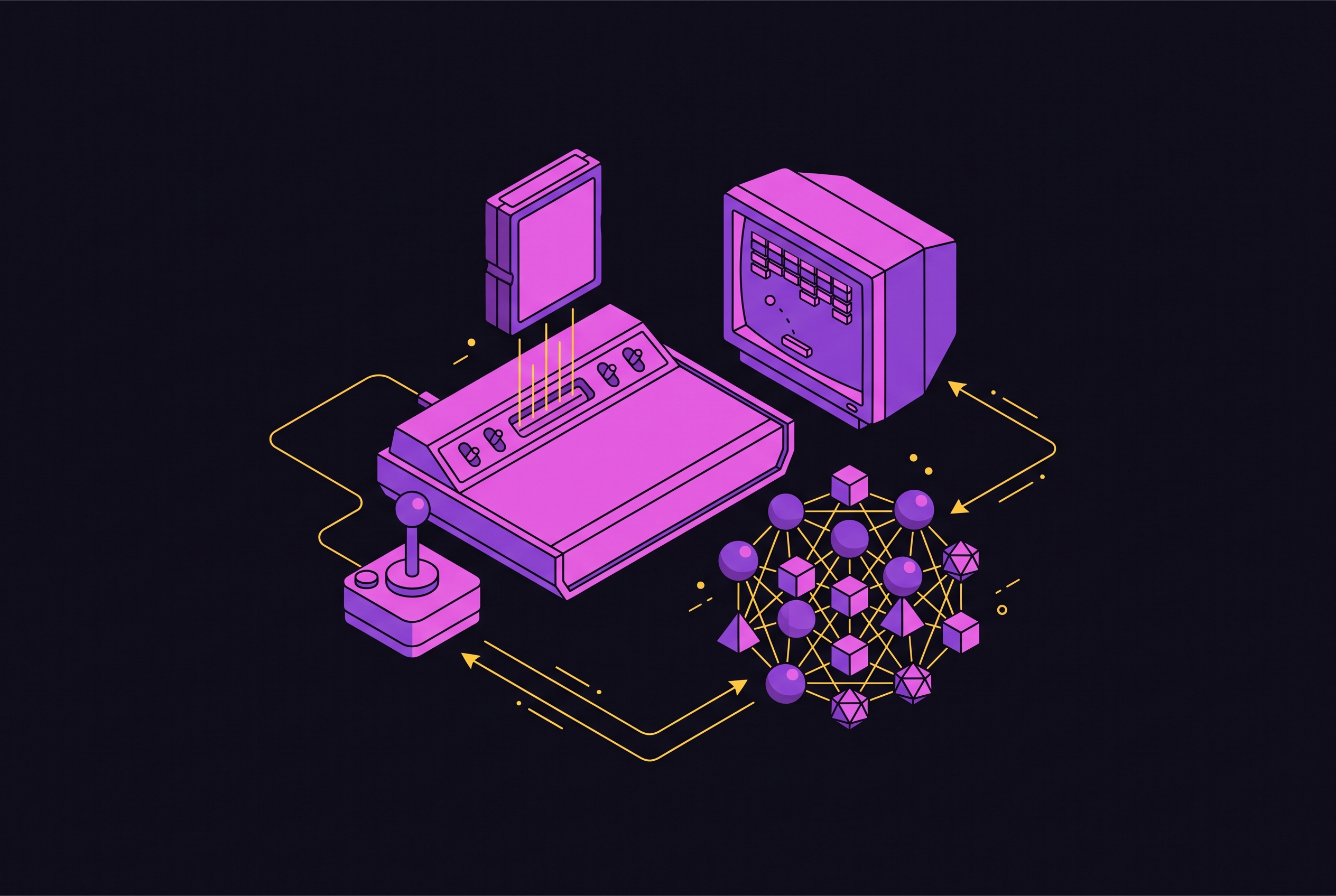
Human Gameplay Demonstrations as Offline RL Data
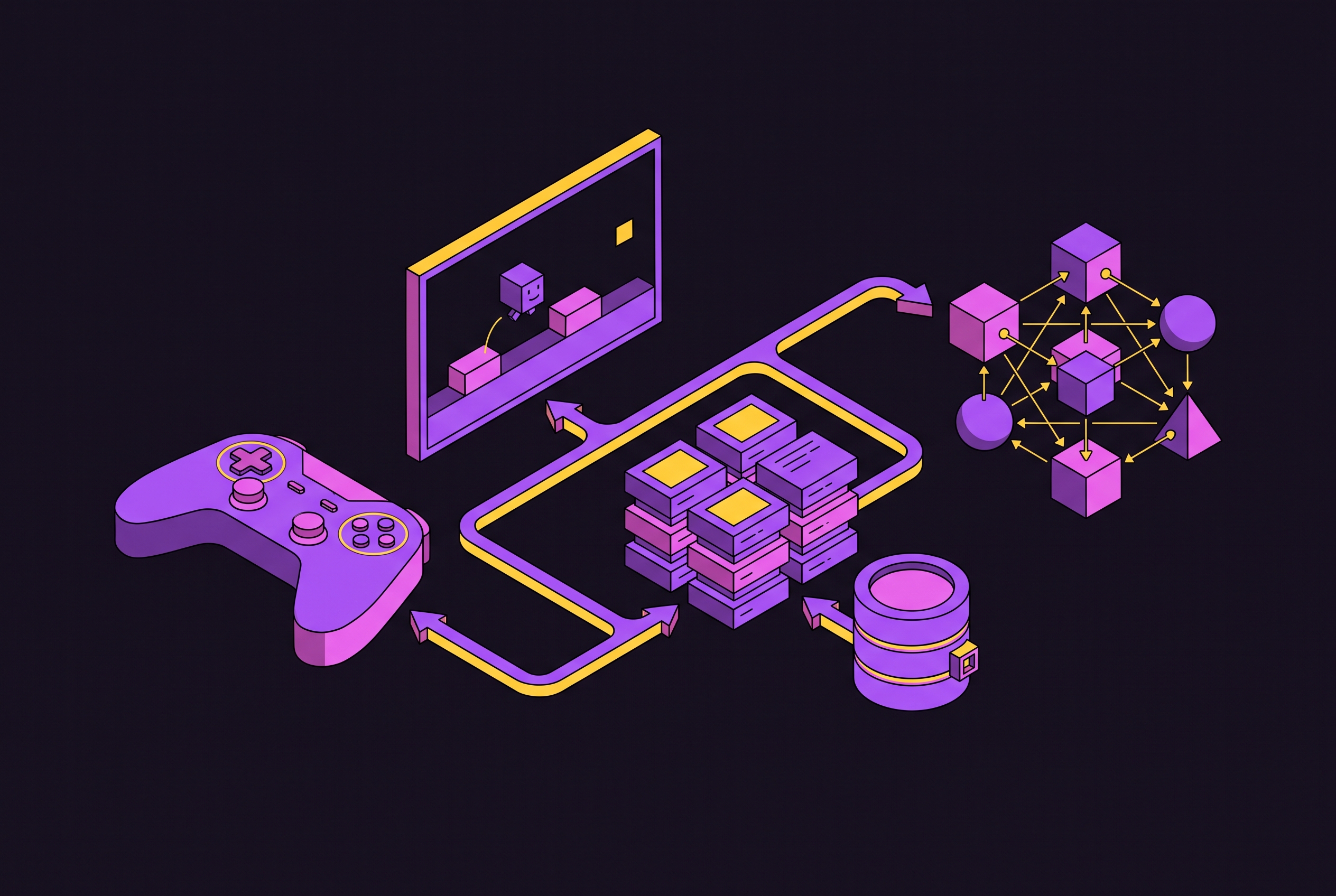
Offline reinforcement learning starts from a strict premise: a policy has to learn entirely from data collected in advance, with no live environment to test against while training runs. That constraint sounds technical, but it decides where the method can be used. Robotics, autonomous driving, and any domain where a bad action carries real cost are where offline RL earns its keep, precisely because nobody can let a half-trained policy steer a car through an intersection just to see what happens.
The policy is only as good as what sits in the dataset. Narrow coverage, bias baked in by whatever collected the data, and the gap between the data's behavior and the policy's learned behavior (distributional shift, more on that below) all drag outcomes down. So practitioners end up choosing between two main sources. Agent-generated replay data is cheap to produce and scales easily, but it tends to be narrow: an agent settles into a groove and stops trying anything unusual. Human demonstrations are the opposite bet, richer in content but far messier to work with, and that messiness is not a flaw to engineer away. It is the reason the data is worth collecting.
What human gameplay recordings supply beyond agent rollouts
A single corpus of human gameplay usually holds novice attempts sitting right next to expert runs. That mix is essential to the training itself. It means the dataset contains both the clean path to a goal and the messier trajectories where someone had to recover from a mistake along the way.
Recovery matters most, and agent replay almost never provides it. When a human player fumbles and corrects course, that correction gets recorded, and those recovery traces are rare in either expert-only datasets or agent replay logs. A policy that never sees a recovery during training has no idea what to do once it lands somewhere it shouldn't, which is exactly where deployed systems end up sooner or later.
Human players also try things no optimization process would bother with: odd routes, unconventional strategies, moves that look inefficient on paper but reveal something about the state space. Agent replay, once training stabilizes, converges onto a narrow behavioral mode and stays there. That's efficient for the agent and thin as training data.
There's a plainer, almost boring advantage too. Libraries of human gameplay footage already exist at scale, across countless games and genres. Collecting more is a matter of marginal cost, nothing like the expensive, session-by-session setup real-robot data collection demands.
The benchmark datasets that put human gameplay into the research pipeline
D4RL exists because the online RL benchmarks that came before it weren't built for the offline setting. Prior work leaned heavily on replay buffers pulled from partially-trained online agents, data that looks nothing like what a real offline RL deployment would actually have on hand. D4RL corrected for that by folding in data from hand-designed controllers and human demonstrators, plus multi-task datasets and mixtures spanning expert, suboptimal, and undirected policies.
The Atari Grand Challenge Dataset filled a related gap on the Atari side. At release, it was billed as the largest and most diverse public dataset of human Atari 2600 replays, built specifically because human demonstration data had been hard to get, and that shortage was holding back progress on data-efficient RL.
Robomimic is where the machine-versus-human distinction gets tested directly, across four manipulation tasks: Lift (grasping and lifting a cube), Can (transferring a can into a target bin), Square (placing a square nut onto a peg), and Transport, a bimanual task moving a hammer between containers. The Multi-Human datasets gather demonstrations from six operators of varying skill, grouped informally into "Worse," "Okay," and "Better" tiers, with each operator contributing 50 demonstrations per task, 300 per task in total https://robomimic.github.io/study/ https://arxiv.org/pdf/2608.20208. Across the three tasks in the core comparison, that adds up to 900 trajectories and 174,614 transitions https://arxiv.org/pdf/2608.20208. A separate Proficient-Human variant strips out the mixed-skill design entirely: 200 demonstrations from one skilled operator, collected through RoboTurk https://robomimic.github.io/study/. Offline RL methods that handle mixed-quality machine-generated data reasonably well tend to struggle when the mixed-quality data comes from humans instead. That's an early sign that human and machine data differ in kind. They're different in kind.
D5RL showed up later, once earlier benchmarks had started to saturate, meaning top methods were bumping against a ceiling and no longer separating from each other in any useful way. It's built on models of real robotic systems and includes more than 20 hours of demonstration and play-style data gathered from human teleoperators, layered alongside scripted data sources https://openreview.net/forum?id=Aj1wftldeR. DROID sits next to this line of work on a different scale entirely: 65,000 demonstration trajectories, 350 hours of interaction, spread across 564 scenes and 86 tasks, gathered by 50 collectors over 12 months https://openreview.net/forum?id=Ml2pTYLNLi. That dataset size starts to resemble the kind of labeled-data scale other corners of machine learning have long taken for granted.
Distributional shift and the double-edged nature of human data's diversity
Distributional shift causes most of what goes wrong in offline RL, and it comes from two directions at once. First, the training data reflects one distribution of states, whatever the person or policy that generated it happened to visit, while the policy learned from that data produces a different distribution once it actually runs. Second, improving a policy means evaluating its Q-function on actions the dataset never contains, out-of-distribution actions the network has no grounding for, and that gap tends to produce Q-value overestimation.
Human data's diversity swings from asset to liability depending on which way it's cut. Expert-only human data narrows coverage to a thin slice of state-action space, which is a particular problem for imitation learning, where small errors compound: one wrong step nudges the agent into a state the expert never visited, and nothing in the data says what to do next.
Mixed-quality human data solves that coverage problem and opens a different one. Widening the pool of operators widens coverage, but it also makes the action distribution highly multimodal. The same state ends up paired with very different actions depending on which operator happened to be at the controls that day, and that multimodality makes value estimation harder in a structural way, making it more than just noisier.
The Robomimic result makes clear this concern isn't hypothetical. Algorithms built to cope with mixed-quality data from machine sources don't automatically transfer that competence to mixed-quality human data. The multimodality baked into human behavior is a structurally different problem from the kind of noise an agent's own training process produces, and solutions built for one don't carry over to the other.
What the algorithm choice controls when data is human-generated
Four algorithm families dominate this space, and each one bets on something different about what the data looks like. Behavior Cloning simply mimics whatever actions the demonstrations contain. It does well on Proficient-Human data, where the actions are consistent enough that mimicry is a sound strategy, but it degrades on mixed-quality demonstrations because it treats every action as equally worth copying, good or bad.
Conservative Q-Learning takes the opposite approach: it learns a Q-function that deliberately lower-bounds the true value of a policy, directly countering the overestimation that distributional shift produces. Implicit Q-Learning sidesteps the problem from a different angle, avoiding queries on out-of-distribution actions entirely during training, though it can be unstable and sensitive to hyperparameters in the offline setting.
Sequence modeling, the Decision Transformer line of work, reframes the whole problem as conditional sequence prediction rather than value estimation. Multi-Game Decision Transformers pushed this into multi-task territory, training across many Atari games at once, but empirically these methods do better on machine-generated data in Robomimic than on human data, another sign that human trajectories carry a different statistical texture than agent-produced ones.
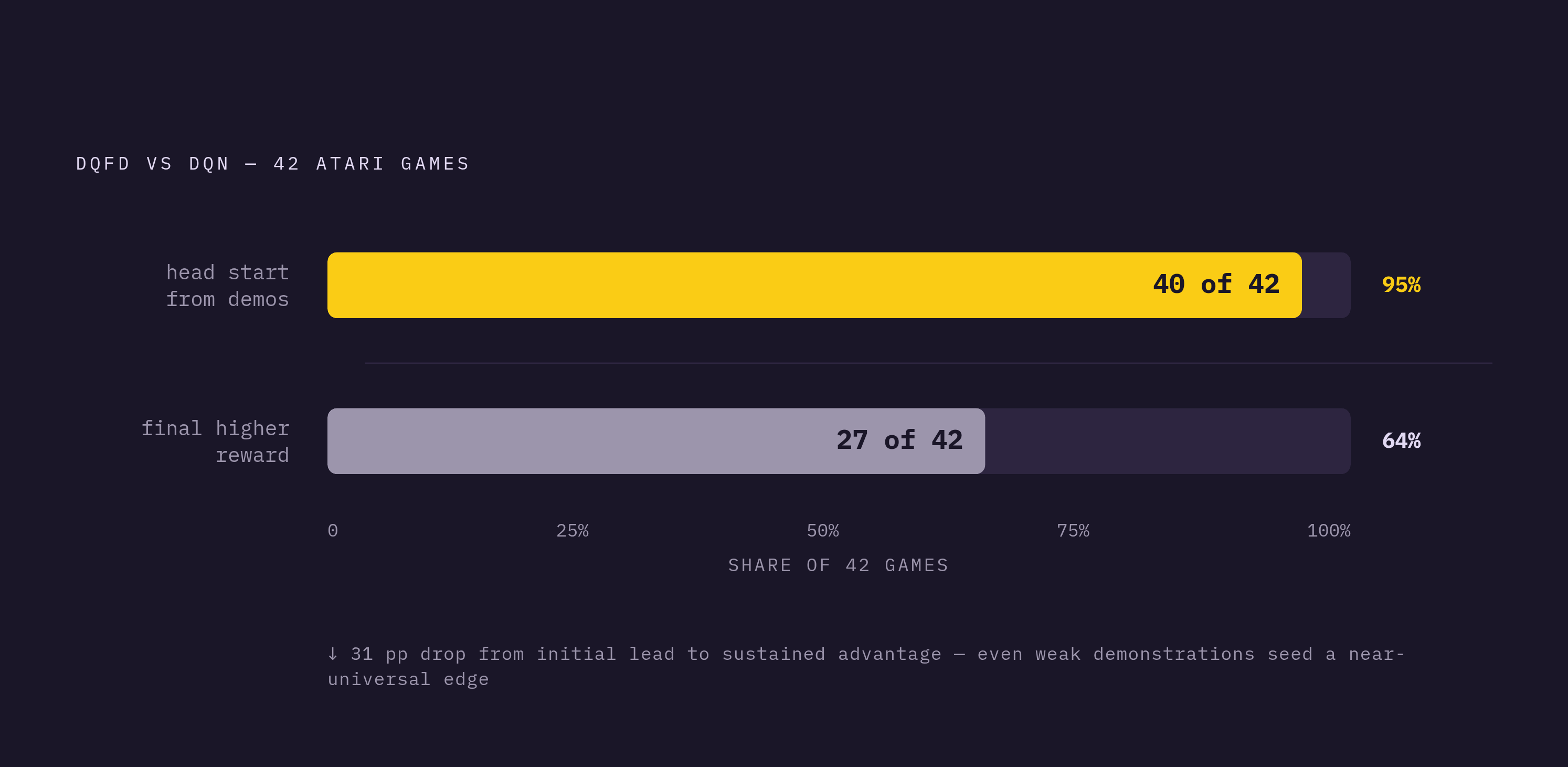
Deep Q-Learning from Demonstrations blends temporal-difference learning with a large-margin classification loss on the demonstrator's actions. Against DQN, it starts out ahead on 40 of 42 Atari games and finishes with higher average reward on 27 of 42, and it learns faster than DQN even when the demonstrations feeding it are poor quality https://www.researchgate.net/publication/331858099_Atari-HEAD_Atari_Human_Eye-Tracking_and_Demonstration_Dataset https://www.researchgate.net/publication/331858099_Atari_Human_Eye-Tracking_and_Demonstration_Dataset. That's a real argument against throwing out weak demonstrations just because they're weak.
The finding that cuts against intuition comes from a systematic study out of UC Berkeley and CMU (Park et al.): the algorithm used to extract a policy from a learned value function often matters more for final performance than the value learning objective itself. Switching from value-weighted behavior cloning objectives like AWR to behavior-constrained policy gradient methods such as DDPG+BC produced real gains in both performance and scalability. Policy extraction deserves to be treated as its own design decision, not an afterthought bolted onto whichever value function got trained. In practice, match the algorithm to what the data actually looks like: BC as a baseline on clean expert data, CQL or IQL when the data is mixed and the policy has to outperform the people who generated it, sequence modeling when the setting is multi-task and the data leans machine-generated or heavily structured.
Hybrid approaches that use human data to seed online improvement
A policy trained purely offline, on a fixed batch of human data, will run into distributional shift the moment it's deployed into a live environment it never saw during training. Online RL can correct that drift, but it needs a decent starting point of its own, or it's stuck facing a hard exploration problem with no signal to work from. Human data is one of the more sensible ways to hand it that starting point.
Imitation Bootstrapped RL, from Hu and colleagues at Stanford, trains a separate imitation policy on human demonstrations first and then puts that policy to work in two ways once online RL begins. The approach sidesteps the usual headache of tuning a regularization weight between imitation loss and RL objective (a hyperparameter search that's simply impractical to run in a real-world deployment), and it shows its strongest gains on the harder tasks in the suite.
The Robo-ValueRL framework, from Xia and colleagues, tackles the offline-to-online transition from a different angle, built around history-conditioned value estimation checked against global-progress and local-preference reliability metrics. Those value estimates then feed into quality-conditioned policy pretraining and a residual module that adapts online. Tested across 240 hours of offline demonstration and more than 3,000 online rollout trajectories, downstream performance tracked closely with how reliable the value function was. Where the value function held up, value-guided offline RL scaled further than quality-agnostic behavior cloning managed to.
The pattern across both comes from the same underlying mechanism, despite the different machinery. Human demonstrations do their most useful work not as the entire training signal on their own, but as a curriculum, something that narrows down which states and actions need exploring and gives the value function a stable starting point before online data takes over the heavy lifting.
Data quality, coverage, and quantity: how the three interact in practice
Quality and coverage pull against each other, and no dataset maximizes both. Expert-only data maximizes the quality of any given demonstration but narrows the state-action space to whatever the expert happened to visit. Mixed-quality data widens that coverage but drags in the multimodality that makes value learning harder. Neither extreme wins, and anyone treating this as a simple quality-first tradeoff is missing what the data actually shows.
Park et al.'s study gives a fairly direct verdict on which side to lean toward: suboptimal data with broad coverage tends to help a policy generalize better than narrow, high-quality data does, across a lot of practical settings. Coverage beats purity once the policy has to work across a deployment distribution wider than whatever the demonstrations happened to cover, and that's the opposite of what most intuition about "clean data" suggests.
Quantity alone doesn't fix a coverage problem. The structural diversity produced by different skill levels, different strategies, and the recovery paths that occur when someone makes a mistake and works their way out of it is what makes human gameplay data scale well.
A few habits follow. Curate for coverage before curating for polish, making sure the dataset actually spans the states a deployed policy will run into, not just the states that were easiest or most flattering to demonstrate. Keep the suboptimal and recovery trajectories rather than filtering them out for only the cleanest runs, since DQfD's results show learning can go faster even off poor demonstrations. Where high-quality demonstrations are scarce, tools like MimicGen can amplify what little exists rather than forcing a costly re-collection from scratch. And match the algorithm to the data's actual quality profile: BC for clean expert data, CQL or IQL for mixed-quality data, hybrid offline-to-online setups wherever deployment involves real distribution shift.
The place of human gameplay data in a broader offline RL workflow
A workflow that takes human gameplay data seriously starts before any data gets collected, not after. The deployed policy will run into certain states, and the dataset needs to cover those states, including the ones that are inconvenient or unattractive to record. Collection should deliberately mix operator skill rather than defaulting to a pool of experts, following the Robomimic MH structure of Worse, Okay, and Better operators contributing 50 demonstrations each, since mixed-proficiency data outperforms a uniform pool of experts.
Algorithm choice comes next, and it should follow from the quality-coverage tradeoff rather than from whichever method happens to be most cited that year. BC, CQL/IQL, and sequence modeling each assume something different about the data, so the choice comes down to that tradeoff analysis rather than defaulting to the most popular method.
Planning has to extend past the offline phase too. Offline-trained policies meet distribution shift the moment they're deployed, so the offline stage should aim to produce a stable value function and a policy that degrades gracefully outside its training distribution, rather than one that falls apart the moment it steps outside what it saw during training. Validation needs to happen on real hardware or genuinely held-out scenarios, beyond benchmark scores. The Real Robot Challenge 2022 made clear that strong simulation results don't automatically carry over once real hardware gets involved.
Some questions here stay open. There's no reliable way yet to measure a dataset's coverage before training starts, so gaps only become visible after a policy has already failed in some state nobody thought to check. It's also unclear how mixed-quality human data should be weighted or filtered without stripping out the recovery and exploratory traces that make it valuable. And whether style-conditioned offline RL, which represents behavioral diversity explicitly instead of averaging over it, can recover value that standard offline RL methods currently throw away, remains an open research question.
Human gameplay's diversity is a structural property of who generated it and how many different ways they approached the same task. It's a structural property of who generated it and how many different ways they approached the same task. That diversity only pays off when curation, algorithm choice, and deployment planning treat it as something to manage deliberately, not noise to average away before training even starts. DQN agents were trained on each of 60 Atari 2600 games for 200 million frames, and for each game, the DQN Replay Dataset drew on five runs of 50 million transitions each https://www.tensorflow.org/datasets/catalog/rlu_atari. Within a broader offline RL workflow that incorporates human gameplay data, CQL learns policies that attain 2–5 times higher final return than existing offline RL methods on both discrete and continuous control domains (CQL, https://dl.acm.org/doi/10.5555/3495724.3495824).
Sources
- Robo-ValueRL: Reliable Value Estimation for Offline-to-Online Reinforcement Learning
Described the Robo-ValueRL framework's history-conditioned value estimation, reliability metrics, quality-conditioned pretraining, and results across 240 hours of offline demonstration and 3,000+ online rollouts.
- Multi-Game Decision Transformer in RL
Provided background on Multi-Game Decision Transformers and their application to multi-task Atari training as part of the sequence modeling algorithm family discussion.