Player Behavioral Telemetry as Intent Signal for Imitation Learning
Inferring player intent from behavioral data enables AI systems to learn realistic game strategies.
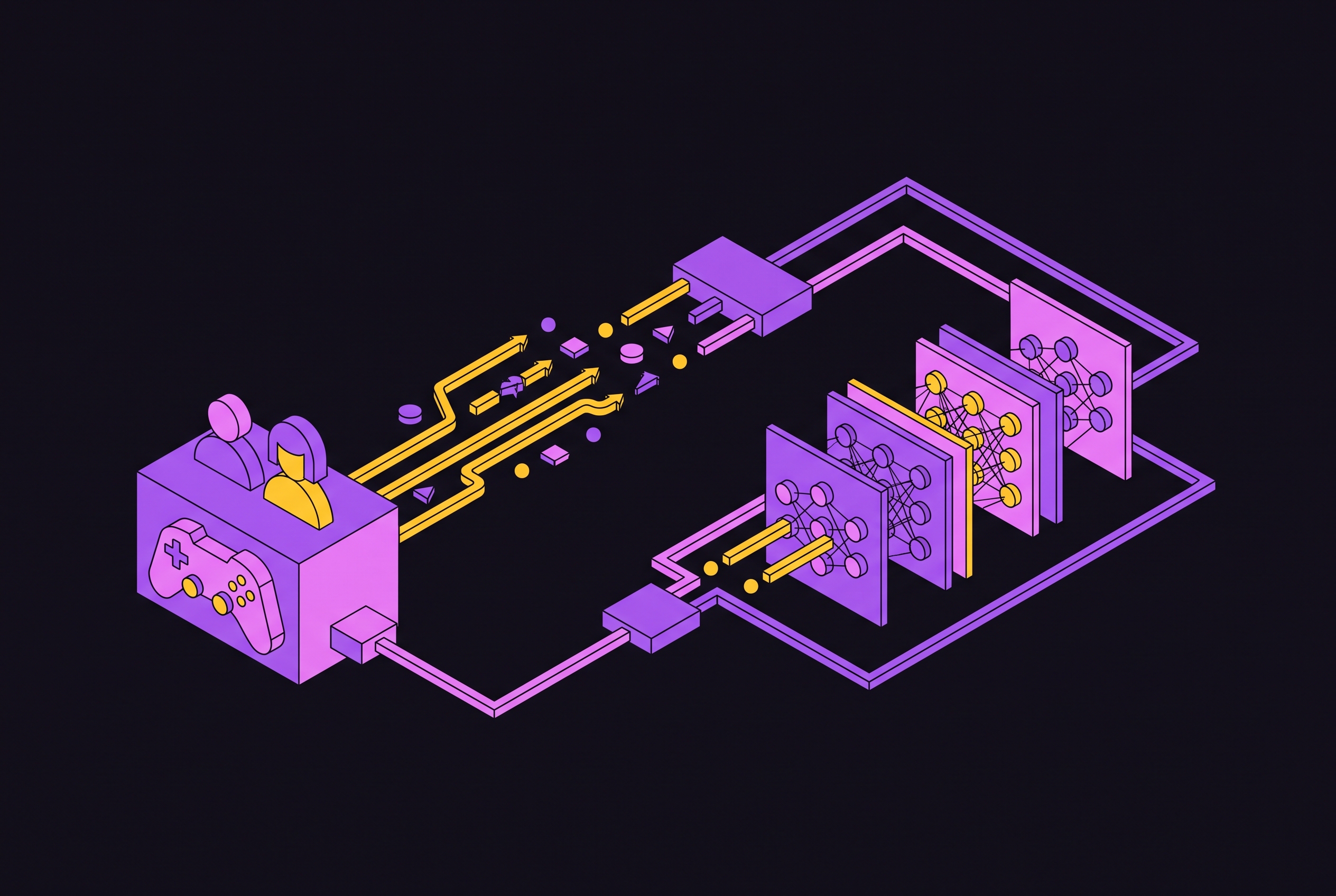
Player behavioral telemetry is a timestamped record of observable actions and context. It is not a record of goals, and closing that distance is the engineering challenge the rest of this piece works through. A telemetry pipeline captures in-game actions, performance indicators, triggered events, and scene content: the game system's side of the interaction, logged at the moment it happens. What it does not capture is the player's goal at any given instant, the reasoning behind a choice, or the weight a player placed on an option they considered and rejected. A player sitting at a controller produces far more than button presses: behavioral and physiological signals pass through input interfaces constantly, but standard telemetry pipelines record only the action output, not the internal state that produced it. Lopes et al.'s systematic review draws a line between player sensing, meaning what gets recorded, and player experience modeling, meaning what gets inferred from it, and treats these as two separate stages precisely because the raw signal does not explain itself. Telemetry tells you what happened. It does not tell you why.
Imitation learning and telemetry as a demonstration of intent
Imitation learning does not close that gap. It makes a bet that the gap is small enough to cross by training a policy that reproduces the patterns found in recorded actions. The classical assumption behind the method holds that demonstrations come from an agent pursuing some coherent goal, so copying the actions should amount, approximately, to copying the goal. Two architectures sit at opposite ends of how explicit that copied goal becomes. Behavioral Cloning treats telemetry as a set of labeled state-action pairs and learns the mapping between them through ordinary supervised learning. There is no explicit representation of intent anywhere in a BC system. Intent, if it exists at all inside the model, lives implicitly in the policy's weights, invisible to inspection. Inverse Reinforcement Learning takes a different route: rather than copying the actions directly, it tries to recover the reward function that would make those actions rational in the first place. That reward function is the inferred intent made explicit, something a researcher can actually look at and question. Multi-agent IRL pushes this further still, modeling each agent's intent as its own reward function instead of simply predicting where each agent will move next, which separates goal-directed reasoning from behavior that merely correlates across agents. Luo et al., surveying AI across the game industry, place this whole activity under a role they call "Model Players and Games," distinct from an AI system that plays a game or one that helps design it, and holding its own standards for what counts as evidence that the model actually works.
Three cases at different scales of intent
When action patterns in telemetry are stable and intent holds steady across a session, the inference chain produces policies that genuinely work, though what counts as "working" shifts depending on what scale of intent is being targeted. Start with population-level signal. Dehpanah et al. (2021) found that behavioral features engineered from Battle-Royale match telemetry predicted player skill rank better than mainstream rating systems managed to. Some of those features only carried information for specific player groups: certain behavioral signals only mean something for certain kinds of players. Move up a level, to style-level intent. Mirror Mode, built in Unity for Fire Emblem Heroes by Smid, van der Putten, and Plaat in 2025, combined GAIL, BC, and PPO to mimic a specific player's strategy and hand it back to them as an opponent. The system imitated defensive play well. Offensive strategy proved harder to reproduce, which shows that even within a single player's own telemetry, some intent signals are easier to recover than others. Push to the finest grain, individual-level intent, and Maia4All (Tang et al., 2026) learns a set of player prototypes in chess, then adapts an embedding using as few as 20 games' worth of positions. Move prediction accuracy reaches roughly 53.2% in that low-data setting, an improvement over the Maia-2 baseline. That result demonstrates that telemetry-derived intent signals can be individuated at a fine grain, not only averaged across a population. Each of these three cases rests on a different assumption about what the underlying telemetry represents, from a population trend down to one person's style.
What makes telemetry a useful signal for downstream applications
Telemetry-derived intent matters to studios because it replaces work that would otherwise have to be done by hand. An NPC that needs to behave like a real player does not require a designer to write out its goals line by line; an IL-trained agent can pick up human-like playstyles and strategies directly from recorded play, cutting out a large amount of explicit programming. The same logic extends to quality assurance. Ensemble IL models can imitate a human player while still exploring a level, which automates a layer of QA coverage that would otherwise need live testers at the controls, and Gharbi et al. (2024) showed PPO, BC, and GAIL agents all managing to mimic human behavior convincingly across a range of games. Dynamic difficulty systems lean on the same mechanism: Lopes et al.'s review identifies telemetry as the dominant signal across every empirically evaluated system for affect-driven adaptation, turning content tuning into a closed loop driven by what players actually do. Not every approach replays telemetry directly. The UBCL framework, from Cilan and Özgövde, defines player behavior inside a continuous N-dimensional space and samples target behavior vectors from it instead, which works well for playtesting and for standing in when a human player drops out of a match, and it avoids some data-quality headaches by not requiring large stores of recorded trajectories. None of this guarantees that players will actually enjoy the result. In the Mirror Mode study, participants recognized their own retreating tactics played back at them, which increased engagement in some cases but risked breaking immersion in others. Whether an inferred intent is legible to the player it was drawn from is itself a design decision, not a side effect.
The causal confusion problem: why more telemetry data can produce worse intent inference
Behavioral Cloning cannot tell an action that caused a good outcome from a feature that merely happened to show up alongside one in the training data. The training procedure has no awareness of the causal structure linking the expert to the environment; it only sees pairs of states and actions, never the mechanism that connects them. This produces causal misidentification: correlates of an expert's actions are, in practice, indistinguishable from genuine causes once they are sitting in the same demonstration set. The counter-intuitive part is what happens when more data gets added. Additional telemetry often supplies more spurious correlates for the model to seize on, making the misidentification worse. Sequential action compounds the issue, since later observations are effects of earlier actions, and that creates a causal structure layered enough that a model relying purely on correlation cannot sort it out. IRL does not escape this cleanly either. It recovers a reward function consistent with the trajectories it is given, but more than one reward function can rationalize the exact same behavior, so the intent IRL hands back is underdetermined by the telemetry it was built from.
Distributional shift: why a policy that learned intent correctly can still fail at deployment
A second failure mode operates independently of the first. Even where a model has correctly inferred intent from its training telemetry, it will meet states at deployment the original expert never visited, and the intent it learned offers no guidance there. This happens because the learned policy and the expert policy are not identical: the learned policy makes slightly different choices from the start, those choices lead to slightly different states, and the divergence compounds the further the policy runs. Imitating an expert's actions along the expert's own trajectory does not line up with the actual task objective once the agent strays off that path, because the intent signal was only ever defined for the part of state space the training data covered. This is what turns demonstration quality into a pipeline-level problem rather than a simple data-collection problem: even telemetry drawn from genuinely skilled players only covers the particular slice of the game those players happened to visit. Distributional mismatch appears even when a model never leaves its training domain, either. The UBCL framework reported moderate degradation on its cooperation and mobility dimensions, attributed in part to a sampling artifact in how the mobility metric was measured, inside the very domain it was built for.
How demonstration quality and feature engineering shape pipeline inference
What a pipeline can infer about intent is capped by the quality of the demonstrations feeding it and by the choices made when turning raw logs into usable features. Telemetry drawn from an entire player population, rather than a curated set of experts, tends to be noisy and inconsistent, and an IL system trained on it ends up learning a blend of intents rather than one coherent one. Gathering enough high-quality labeled demonstrations to avoid this costs real time and money. When demonstrations are suboptimal, the resulting policy is suboptimal too, because the intent it was asked to find was genuinely muddled to begin with: a pipeline cannot recover an intent that the demonstrator never actually held. Handcrafted feature frameworks such as Behavlets try to make intent more legible by pairing psychological traits with sequences drawn from telemetry, but they depend on descriptors a person had to define by hand, which limits how well they carry over to new genres or to player populations that shift over time. Live multiplayer games add an adversarial twist to all of this: gray-area behavior such as macro use, latency manipulation, or semi-automated scripting produces an action stream shaped like a human's without being motivated like one, and any intent inference trained on that data inherits the distortion.
Hybrid pipelines and richer signal sources
No single method handles causal confusion, distributional shift, and demonstration quality at once. That is why the field has been moving toward hybrid pipelines that combine behavioral cloning with reinforcement learning, data augmentation, or richer semantic signal. One common fix pretrains with BC and then fine-tunes with RL on an aggregated dataset, exposing the policy to states the original demonstrations never covered and correcting its behavior there with reward feedback, directly targeting distributional shift. GAIL offers a middle path: its adversarial discriminator gives the policy a dense training signal that keeps it closer to the demonstration distribution than plain BC would, reducing distributional shift without eliminating it, a technique used in both the Fire Emblem Mirror Mode study and in Gharbi et al.'s multi-game experiments. Supervised Contrastive Imitation Learning, introduced in 2025, folds a SupCon loss into continuous output spaces, and experiments across Astro Bot, Returnal, and several Atari games showed better representation quality, faster convergence, and stronger generalization than models trained with supervised action-prediction loss alone, a gain in representation quality that does not require collecting more demonstrations. Zhang and Long's 2025 framework, "Learning to Play Like Humans," guides a language model through interactive fiction using structured map building, action learning, and feedback-driven analysis of its own experience, moving intent inference from individual action tokens up to goal-level semantic representations. Operating at the level of goals rather than keystrokes sidesteps some causal confusion. Lopes et al.'s review is careful to note that machine learning methods inside complete adaptation loops still run into limits from data availability, transparency, and the practical difficulty of runtime integration. Each of these approaches improves one or two specific failure modes. None of them closes the full loop, and validating that a complete pipeline works end to end remains genuinely hard.
Where the inference chain is structurally limited
Some of what has come up in this piece is not a gap that better engineering will eventually close. Causal confusion exists because a stream of state-action pairs does not, by itself, encode the mechanism that produced it, and no amount of additional telemetry changes that fact about what the data format can represent. Distributional shift exists because any finite set of demonstrations covers a finite slice of a state space, and a policy will eventually meet territory the demonstrators never walked. IRL's underdetermination exists because more than one reward function can explain the same recorded behavior; the inferred intent, however inspectable it looks on the page, is never fully pinned down by the trajectories used to build it. The three cases examined earlier, population-level ranking, style-level mimicry, individual-level move prediction, succeeded by targeting a scale of intent where the telemetry actually carried enough signal to support the inference. That is not evidence that the inference chain works everywhere; it is evidence that it works where the match between signal and target is a good one. The honest claim a pipeline can make about player intent is bounded by the slice of behavior it was trained on, the granularity it was asked to model, and the part of state space its players actually visited. The distance between an action and the goal behind it is not a measurement error waiting to be corrected; it is the condition the entire field is built to work around.
Sources
- TYPE Original Research PUBLISHED 20 March 2026 DOI 10.3389/frai.2026.1730018
Provided the framework distinguishing player sensing from player experience modeling, and identified telemetry as the dominant signal in affect-driven adaptation systems.
- arXiv:2505.01351v1 [cs.HC] 2 May 2025 PREPRINT, MAY 2025 1
Supplied the systematic review findings on player sensing versus experience modeling and the role of telemetry in empirically evaluated adaptive systems.
- AI for Games in the Foundation Model Era
Provided the taxonomy placing player modeling as a distinct role from game-playing or design AI, and the 53.2% move prediction figure cited for Maia4All.
- UBCL: A Reinforcement Learning Framework for Controllable and Diverse Player Behaviors
Described the UBCL framework's continuous behavioral space approach and its reported degradation on cooperation and mobility dimensions.
- Winning Isn't Everything: Enhancing Game Development with Intelligent Agents
Supported the discussion of IL-trained agents picking up human-like playstyles for NPC behavior and automated QA coverage.
- Augmenting Game AI with Deep Reinforcement Learning
Provided evidence from Gharbi et al.'s multi-game experiments showing PPO, BC, and GAIL agents mimicking human behavior, referenced in both the applications and hybrid pipelines sections.