Skill Discovery From Unsupervised Play Trajectories
Agents learn reusable behaviors through unsupervised play, avoiding hand-designed reward functions.
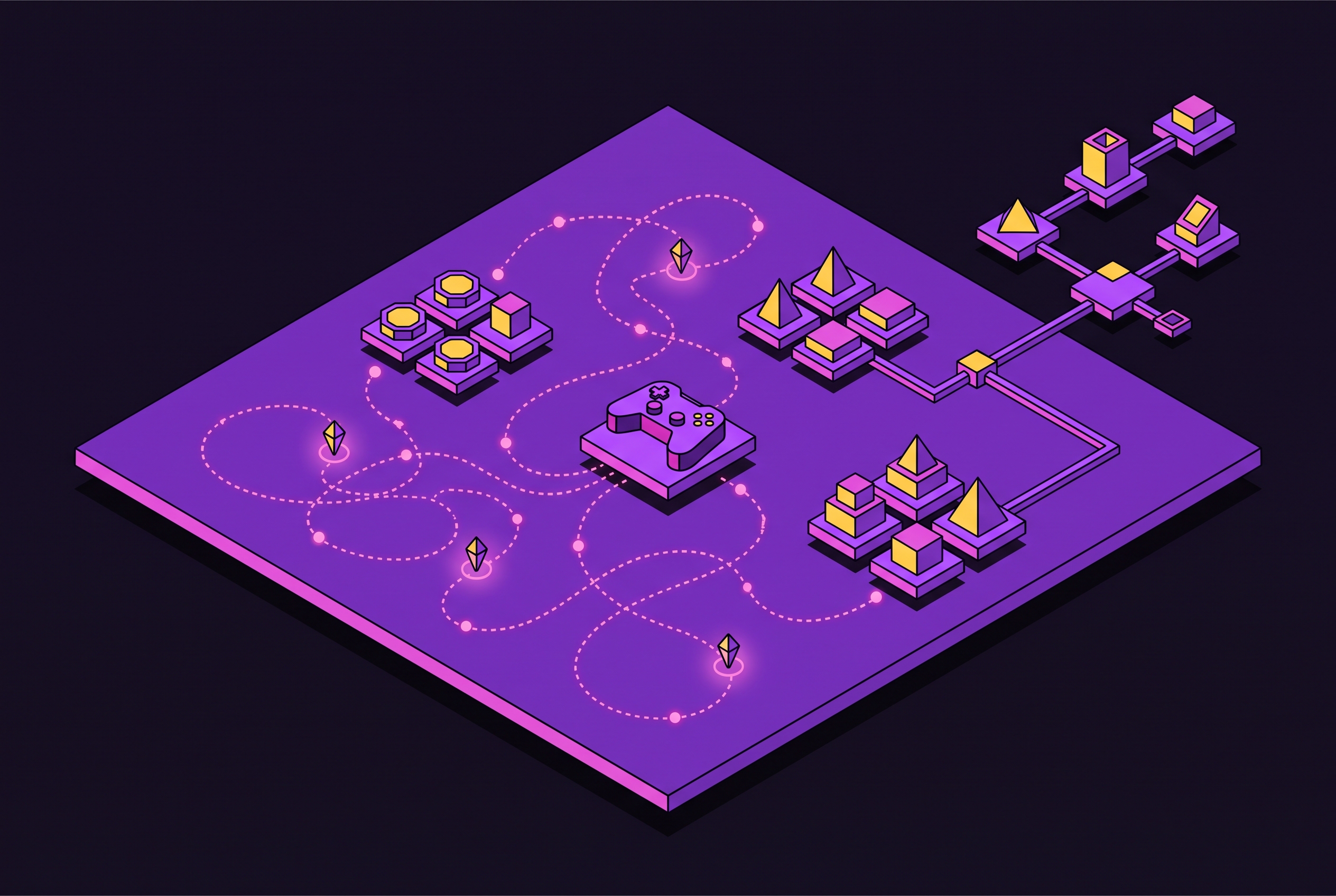
Skill discovery from unsupervised play works by extracting structured, reusable behaviors from an agent's reward-free interaction with its environment, before any downstream task has been named. The method matters because it replaces the brittle work of hand-designing a reward function for every behavior an agent might someday need with a general-purpose repertoire the agent builds on its own.
What unsupervised skill discovery is
Reward engineering does not scale. Both problems have the same answer: unsupervised skill discovery separates competence from task-specification. The agent interacts freely with its environment, and reusable behaviors emerge as a byproduct of that interaction rather than as the target of an externally imposed reward.
The paradigm takes a specific formal shape: a two-stage loop. The first stage is reward-free pretraining, where the agent maximizes an intrinsic objective, a signal it generates for itself. The second stage is adaptation, where a task reward finally appears and the agent must map that task onto the behaviors it already knows. Skills, in this framing, are policies conditioned on a latent variable, often written as z. The variable specifies which behavior to run, and the policy carries it out. Pretraining is the process of making that catalog of behaviors as diverse and as reusable as possible.
The payoff of this structure is practical as much as theoretical. Learned skills remove the need to specify a reward for every downstream objective, since a sufficiently diverse repertoire can be adapted quickly once a task appears. They supply the primitives that hierarchical controllers depend on, since a high-level policy can only chain together behaviors that already exist at the low level. And they give an agent a way to demonstrate its own capabilities to a human designer, surfacing what it has learned without anyone needing to ask the right question in advance.
Mutual Information Between Skill Codes and States as the Dominant Intrinsic Objective
Of the available ways to formalize "each skill should produce distinguishable behavior," mutual information between the skill code and the states it visits is the most direct, and that directness is why it became the field's default objective. Diversity, in other words, gets reduced to an information-theoretic decomposition that can be optimized directly.
DIAYN turned that bound into something trainable by introducing a discriminator, a network trained to predict which skill z produced a given state s. The agent's intrinsic reward becomes the discriminator's confidence: the better the discriminator can identify which skill is running from the states it visits, the more reward the policy collects. This converts an abstract information-theoretic quantity into a per-step signal that ordinary reinforcement learning machinery can optimize.
DADS, introduced by Sharma and colleagues at ICLR 2020, extends the same logic to transitions, not just states. DADS does not just make the state s predictable given z; it maximizes I(s'; z | s), the mutual information between the next state and the skill, conditioned on the current state. A skill-conditioned dynamics model is paired with the policy so that each skill becomes predictable not only in where it ends up but in how it gets there, a property that makes the resulting skills usable for model-based planning.
DIAYN skills fail when a meta-controller attempts to compose them hierarchically. The predictability of the transition, not just the state, turns out to be what a higher-level controller needs in order to chain primitives together into longer behaviors.
The core tension MI maximization cannot resolve: discriminability versus state coverage
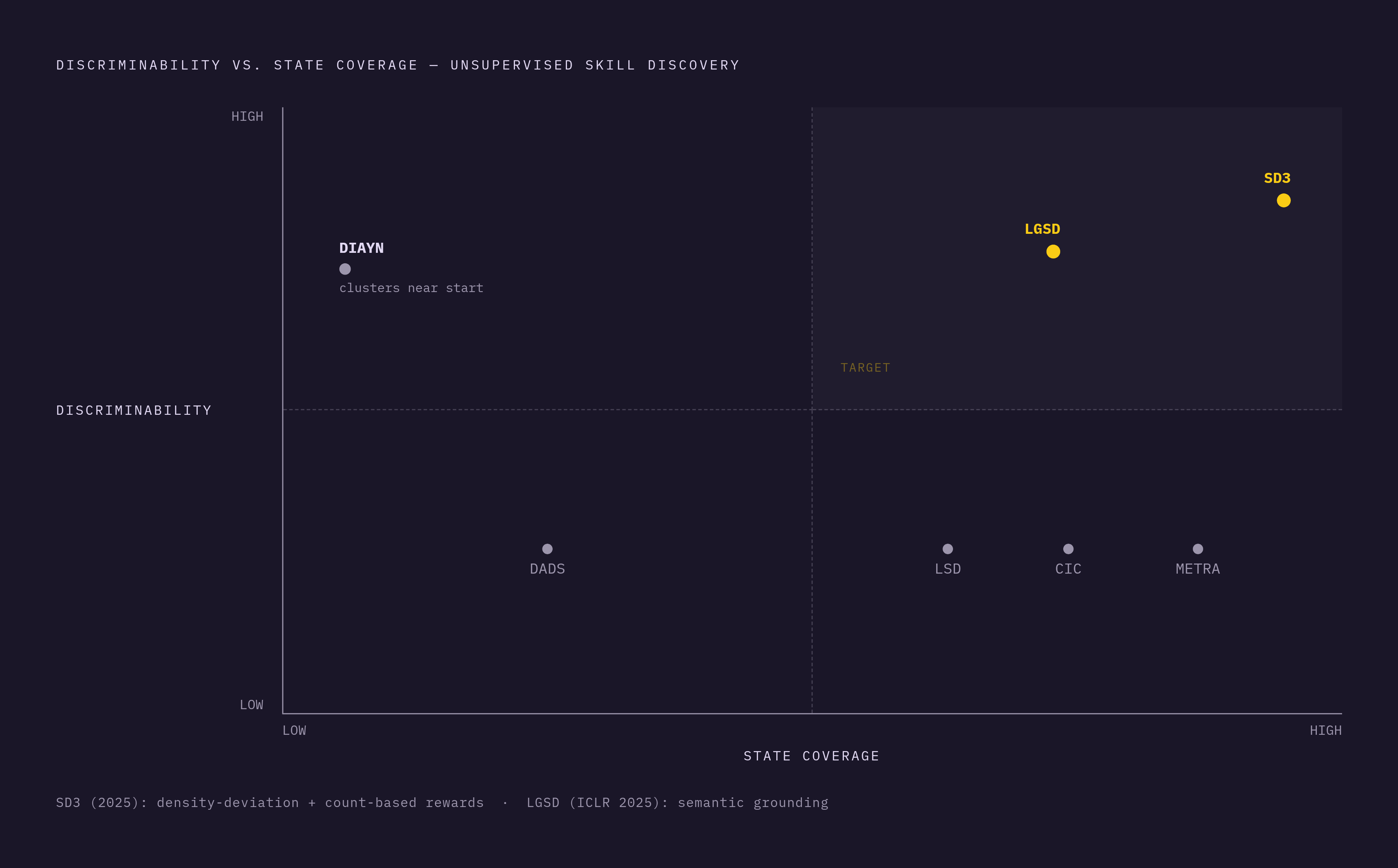
Mutual information maximization and pure state-entropy maximization sit on opposite sides of a trade-off that neither resolves on its own. MI-maximizing methods produce skills that are cleanly separable from one another, but those skills tend to cluster in a narrow region of the state space. Entropy-maximizing methods spread across the state space freely, but the trajectories they produce lose any stable identity, so you can't tell them apart or reuse them as building blocks.
The trade-off shows up concretely in maze navigation experiments.
The mechanism behind MI's under-exploration is a quirk of how the discriminator gets satisfied. A discriminator can separate skills most easily near the start state, because small differences there are enough to tell z codes apart. The policy has no incentive to travel further once that local separability is achieved, so skills cluster close to home rather than spreading across the reachable environment. The problem compounds in high-dimensional settings: the MI estimator itself does not scale directly to large state spaces such as pixel-based environments, so the coverage failure gets worse exactly where state spaces are richest.
Pure entropy maximization avoids the clustering problem but trades it for a different one. The resulting trajectories are hard to extract as discrete, reusable primitives.
Neither failure mode is cosmetic. A discriminable but spatially restricted skill set will miss behaviors a downstream task actually requires, since the agent never learned them. A spatially broad but incoherent skill set gives a hierarchical controller nothing stable to chain, since there is no consistent primitive to call on twice. The field's subsequent methods can be read as successive attempts to hold onto discriminability while forcing skills to cover more of the state space than MI alone will produce.
Lipschitz constraints, contrastive objectives, and metric-aware abstraction for dynamic coverage
A second wave of methods imposes geometric structure directly on the skill latent space, using Lipschitz constraints, contrastive objectives, and metric-aware abstractions to tie skill diversity to actual distances in the environment measured against a discriminator's confidence.
LSD, introduced by Park and colleagues at ICLR 2022, enforces a Lipschitz constraint on the mapping from skill codes to states. Under this constraint, skills that sit far apart in latent space are required to visit states that are far apart in the environment. Diversity is defined by state-space geometry rather than by how easily a classifier can tell skills apart, which removes the incentive that caused MI-based skills to cluster near the start state.
CIC, from Laskin and colleagues in 2022, takes a different route to the same end. It replaces the discriminator with a contrastive objective over state transitions, using noise-contrastive estimation in an embedding space to push different skills toward different, widely separated regions. CIC achieves broader coverage than DIAYN as a result, at the cost already visible in the maze experiment: the trajectories it produces span more ground but look chaotic.
METRA pushes the same idea further through metric-aware abstraction: it connects a compact latent space to the state space by temporal distance. Even so, METRA still fails to produce meaningful behaviors in high-degree-of-freedom systems, which indicates that geometric augmentation alone does not close the coverage gap once the control problem gets sufficiently complex.
What LSD, CIC, and METRA share is a substitution: each replaces the discriminator's soft classification signal with a signal derived from actual distances or contrasts measured in state space. The policy is rewarded for reaching genuinely different parts of the environment, not merely for being classifiable from wherever it happens to end up. That substitution moves the field's skill repertoires toward broader coverage, but it does not, on its own, fully resolve the tension between coverage and discriminability.
SD3's density-deviation objective: separating inter-skill diversity from intra-skill exploration
SD3, proposed by Zheng and colleagues in June 2025, reframes the coverage problem in terms of state density rather than discriminator confidence or latent-space geometry. SD3 does not ask whether a discriminator can tell skills apart; it asks whether each skill's state density deviates from the regions other skills have already explored. That reframing lets skill diversity be decomposed into two separate objectives, each optimized with its own mechanism.
Inter-skill diversity is handled by rewarding a skill for visiting states where other skills' state density is low, a deviation objective that pushes skills apart by density. Intra-skill exploration is handled separately, through a count-based intrinsic reward computed in a learned latent space, which keeps a given skill exploring within its own region. Splitting diversity from exploration this way lets each half of the problem be optimized with the tool suited to it, rather than forcing one objective to do both jobs at once.
The density-deviation objective also carries a theoretical link back to the field's original foundation: it has been shown to resemble the mutual information objective in a special case. That connection grounds SD3 in the same information-theoretic lineage as DIAYN and DADS, but it extends the approach into regimes, such as high-dimensional pixel observations, where direct MI estimation breaks down.
The cost of entangled skills for hierarchical and compositional control
Coverage is not the only property a skill repertoire needs. A second, independent failure mode arises when a single skill variable changes several unrelated aspects of the environment at once, and the literature calls this entanglement. Entangled skills make downstream composition far harder than it has to be, because a controller that wants one specific change has no way to get it without also triggering changes it did not ask for.
DUSDi, presented at NeurIPS 2024, illustrates the problem with a driving example. Suppose a single skill code changes speed, steering, and headlights all at once. It has to rediscover the decomposition itself, in the middle of whatever downstream task it is already struggling with, because the pretraining phase never produced a skill that isolates headlights from the rest.
The cost of entanglement is highest in exactly the settings where hierarchical reinforcement learning matters most: multi-agent systems and household humanoid robots, where many independent dimensions of the state need to be controlled at the same time. SUSD, from Chang and colleagues in January 2026, documents a related finding: even distance-maximizing methods such as METRA, which promote more dynamic skills than pure mutual information objectives, still fall short of engaging every controllable factor or entity in the environment. Coverage can improve while entanglement persists untouched, since the two problems are not the same problem.
Human behavior offers the clearest contrast. Disentanglement, as a design goal, aims to give an artificial agent that same modular structure, rather than leaving it to rediscover the decomposition under pressure every time a new task appears.
Disentanglement through state factorization: how DUSDi and SUSD structure the skill space
The technical answer to entanglement is to decompose skills into components, each of which affects exactly one factor of a state space that is itself assumed to be factored. The decomposition is enforced through a mutual-information objective with two simultaneous goals: maximize the mutual information between a skill component and the one state factor it is assigned to, while minimizing its mutual information with every other factor. Skills built this way are reusable and composable from the start, rather than needing to be disentangled after the fact.
DUSDi implements this with an intrinsic reward made of two terms. The positive term rewards increased mutual information between a state factor and the skill component you assign to control it. The negative term penalizes mutual information between that same component and all the other factors it should leave untouched. Disentanglement is written directly into the optimization target rather than hoped for as a side effect of some other objective.
Making the joint objective tractable required a further step: DUSDi uses value factorization, which allows the disentanglement penalty to be applied to each component separately, avoiding the exponential cost that would come from optimizing over every possible interaction between factors at once. Factored state spaces supply exactly the inductive bias this kind of disentanglement needs.
SUSD approaches the same goal from a different angle, using structured state factorization to make sure the discovered skill set engages every controllable factor or entity in the environment, rather than settling on whichever subset of factors happens to be easiest to distinguish.
The payoff that justifies this added complexity is concurrent composition. Because each DUSDi skill component touches only one factor, components can run at the same time without interfering with one another. An agent can execute "increase speed" and "adjust steering" in parallel, the same way a human driver handles both at once without treating them as a single entangled action. That property is what separates disentangled skills from skills that are merely diverse: diversity alone does not guarantee that two skills can run together.
Semantic grounding through language: how LGSD partially dissolves the coverage/discriminability trade-off
Language-guided skill discovery, introduced as LGSD at ICLR 2025, approaches the coverage and discriminability trade-off from a direction unrelated to geometry or density estimation: it uses language descriptions to constrain the latent skill space from the outset.
The mechanism replaces a purely learned continuous code with language embeddings of skill descriptions, used as the latent z itself. Because the embedding space is organized around semantic meaning, skills that differ in what they mean are encouraged to differ in the states they produce, folding the discriminability objective and the coverage objective into a single prior.
LGSD has been evaluated directly against the methods that define the rest of this account: classical mutual-information baselines including DIAYN and DADS, and distance-maximization approaches including LSD, CSD, and METRA. That comparison gives a direct empirical reading of how much semantic grounding changes skill diversity relative to the established objectives, rather than leaving the claim untested against the field's existing baselines.
A repertoire built this way can be inspected and debugged directly, since each skill's intended meaning is legible rather than locked inside a latent code that only a discriminator or density model can decode.
Sources
- Disentangled Unsupervised Skill Discovery for Efficient Hierarchical Reinforcement Learning
Provided the technical details of DUSDi's disentanglement approach, including its two-term intrinsic reward and value factorization for hierarchical skill composition.
- Unsupervised Skill Discovery through Skill Regions Differentiation
Provided the basis for SD3's density-deviation objective, describing how inter-skill diversity and intra-skill exploration are separated into distinct mechanisms.
- CIC: Contrastive Intrinsic Control for Unsupervised Skill Discovery
Provided background on CIC's contrastive objective over state transitions as an alternative to discriminator-based skill discovery.
- METRA: Scalable Unsupervised RL with Metric-Aware Abstraction
Provided details on METRA's metric-aware abstraction connecting latent space to state space via temporal distance.
- Language Guided Skill Discovery
Provided the basis for the LGSD section, describing how language embeddings replace continuous skill codes to ground skill discovery semantically.
- Unsupervised Hierarchical Skill Discovery
Provided details on SUSD's structured state factorization approach to ensure skill discovery engages every controllable factor or entity.
- Controllability-Aware Unsupervised Skill Discovery
Provided background on controllability-aware objectives that informed the discussion of coverage failures in MI-maximizing methods.
- Learning to Discover Skills through Guidance
Provided background on guidance-based skill discovery methods discussed in the context of the coverage–discriminability trade-off.