Opponent Modeling Transfer Across Game Variants
Separating opponent behavior from game mechanics unlocks models that transfer across rule changes.

Opponent modeling transfer across game variants is an architectural problem that requires more than additional training data. Behavioral tendencies can persist when rules change, but models often encode them in a form that cannot. Progress depends on separating behavioral inference from game-specific inputs while keeping it connected to the policy that acts on it.
Why opponent models fail to travel across game variants
A human card player can take a read on an opponent from one game to the next. A trained AI often cannot do the same. Aggression, cooperation, and bluffing frequency describe tendencies that can persist across variants, yet a model learns their expression through a particular state space, action vocabulary, and reward structure. When those change, the learned representation may no longer identify the same behavior. The failure lies in the encoding even when the tendency remains portable.
Two structural choices explain this brittleness. First, systems often learn behavioral preferences such as cooperation and competition without separating them from the scenario in which they appear. Second, the estimator that infers an opponent’s behavior and the policy that exploits it are built as separate modules. StratFormer, by Caen, Winands, and Soemers of Maastricht University, names this gap explicitly in its 2026 account of prior approaches. Even if an estimate is still useful after a rule change, the policy that uses it may need to read it differently, which forces the pipeline to be rebuilt.
How current game-specific observation spaces trap behavioral signal inside one title
The entanglement begins with the observation supplied to the model. Card indices, unit positions, and action IDs describe behavior using the coordinates of the source game. They are not neutral descriptions of intent. In imperfect-information games, the problem is sharper because private cards are hidden, leaving the model to infer tendencies from observable actions. Those actions already belong to a game-specific vocabulary, so the evidence and its encoding bind the inference to one setting.
The NUS/NTU survey by Luo et al., published in 2026, places this problem across the game AI lifecycle. It states that “control schemes, rules, engine interfaces, state representations, and player contexts often remain setting-specific, so downstream capability claims require validation in their target setting”. Player modeling is among the capabilities for which transfer remains “less established”. Pretrained fixed-architecture approaches also lack generalization guarantees, so success in one target setting provides no assurance that the next game will preserve it.
What existing opponent modeling algorithms guarantee — and what they do not
Most existing opponent modeling algorithms do not guarantee convergence to the opponent’s true strategy, even with unlimited data. Ganzfried’s paper, last revised in January 2026, shows that this can fail even for static opponents drawn from a known prior distribution. This can happen even when the rules stay the same and the adversary does not adapt.
Ganzfried proposes an algorithm that achieves consistency given sufficiently informative observations. It solves a convex minimization problem over the sequence-form game representation. That guarantee is limited to learning the opponent’s strategy within the game. The distinction is essential because consistency and transfer can compound one another’s failures. A representation designed to survive a domain change is not sufficient if the inference procedure cannot reliably recover the behavior it is supposed to represent.
Consistency in the limit is nevertheless an idealization. In real deployments, data is finite and opponents are non-stationary, so a convergence result does not show how well the model will work in practice. It does, however, establish whether the inference procedure has a sound limiting target. Without that foundation, poor cross-game performance is hard to explain. It may come from a broken transfer mechanism or from a modeling failure that was already there in the source domain.
Invariant intermediate representations as one path out of game-specific encoding
A subgoal describes what an opponent is working toward. Different policies can reach the same intermediate objective through different action sequences. This creates a useful point of abstraction. If an unfamiliar policy combines recognizable subgoals, a model can interpret that combination without having observed the entire policy before. Transfer then depends less on matching raw actions and more on recognizing shared parts of behavior.
OMG, by Yu, Jiang, and Lu of Peking University at NeurIPS 2024, implements this approach by inferring subgoals from historical trajectories. Its central property is compositional. Because policies can share subgoals, the model need not encounter every possible policy to recognize a new sequence of familiar objectives. The intermediate representation separates some of the behavioral signal from the exact trajectory that expressed it. This is a principled reduction in what must generalize, rather than a claim that game mechanics can be ignored.
OMG tested the approach in Foraging and Predator-Prey tasks, which included both cooperative and general-sum settings. The inference engine operated across these structurally different multi-agent environments, but each environment used its own subgoal selection mode and a separate pretraining phase. That qualification limits the transfer claim. The work supports subgoal inference as a reusable mechanism. Foraging and Predator-Prey also share more structure than a card game and a fighting game.
Decoupling player control from NPC strategy inside a generative world model
ReactiveGWM, by Wang et al. of Tencent/NUS/HKPolyU et al., takes a different approach in its May 2026 paper. It reports that behavioral modules achieved zero-shot transfer from Street Fighter II to Street Fighter III without retraining or any added annotation. The destination is a distinct game title. The transferred object is a representation of NPC strategy inside a generative world model.
Player actions go into the diffusion backbone through a lightweight additive bias, while cross-attention modules ground high-level NPC strategies such as offense, defense, and control. The strategy becomes a first-class controllable variable. In contrast, treating the NPC as background within pixel simulation leaves no isolated behavioral component to transfer. This lets the model represent interactive logic apart from the game encoding that faces the player.
The Street Fighter result gives this distinction concrete force. It demonstrates that a behavioral module can move between titles when the architecture provides a separate place for it. This aligns the approach with the foundation-model idea of plug-and-play components, but the scope remains bounded. Both games have the same genre, visual language, and control interface. Transfer between fundamentally different action vocabularies, such as those of a fighting game and a card game, remains unvalidated.
Unifying the modeling and exploitation pipeline so transfer does not break at the seam
StratFormer links how an agent understands an opponent to how it chooses a response. Its reported performance gains anchor the benefit of unification in its evaluation. The evaluation covered a single poker variant only. Its architectural contribution is a transformer-based meta-agent that learns opponent modeling and strategic exploitation within one system, reducing the separation between the estimate and the policy that uses it.
The curriculum has two phases with different purposes. The first trains an opponent modeling head while the agent plays GTO, and the second shifts the policy toward best-response exploitation under a per-opponent exploitability schedule. Dual-turn tokens process the decision points of both the agent and the opponent. Causal masking restricts attention to past information, while bucket-rate features encode opponent tendencies across five strategic contexts. Together, these mechanisms let the policy condition on a causally correct opponent model at each step.
StratFormer describes its dual-turn tokens, curriculum, and exploitability-tied regularization as domain-general contributions. Their stated scope includes sequential imperfect-information games with observable opponent actions and a tractable equilibrium baseline. That scope remains a design claim awaiting transfer evaluation. Larger poker variants remain proposed targets. OMIS, presented at NeurIPS 2024, takes a complementary route by using pretrained in-context components for decision-time search, with theoretical guarantees of improvement and stable performance against non-stationary opponents.
The modular fallback: swapping components when full architectural transfer is unavailable
CEO-Poker, Li’s May 2026 work at NYU Shanghai, offers a modular option when there is no unified learned representation. Its five components are an opponent analyzer, an equity calculator, a GTO-oriented player, an exploit player, and a meta-controller. The controller switches between equilibrium and exploitative play based on how strong it judges the opponent to be during play. Components can be swapped or retargeted across poker variants without rebuilding the entire system, although they still require game-specific calibration. The separation can make the system more interpretable and easier to audit for safety, while the controller remains game-agnostic in principle. This provides adaptation at inference time.
The training-time vs. test-time split in how researchers think about transfer
These approaches express two coherent positions on where adaptation should occur. Training-time approaches invest in representations or curricula that encode behavioral structure abstractly enough to survive a domain shift. OMG, ReactiveGWM, and StratFormer pursue different versions of that aim. Their intended payoff is zero-shot or low-shot transfer. An abstraction can appear general because the evaluation preserves the underlying structure that made it useful.
Test-time approaches instead use computation during deployment to respond as behavior changes. OMIS and CEO-Poker’s meta-controller place adaptation at that point, although they provide different mechanisms and guarantees. The tradeoff is additional deployment computation. It also leaves open what the base model captured before adaptation began, since test-time responsiveness does not itself supply training-time representation guarantees.
The cross-environment evidence discussed here comes from related settings, including Street Fighter II to Street Fighter III and Foraging to Predator-Prey. Transfer from the evaluated poker variant to larger poker variants remains a proposal. No method described here has been validated across games that differ in both action vocabulary and reward structure. Specialist performance within a single variant also remains ahead of transferable methods, so these results do not erase the original performance gap.
The disagreement is productive because the approaches accept different costs. Training-time abstraction places more responsibility on the representation, while test-time adaptation places more on computation during interaction. The survey’s requirement for validation in the target setting applies to both.
What the right unit of transfer actually is, and why the answer determines architecture
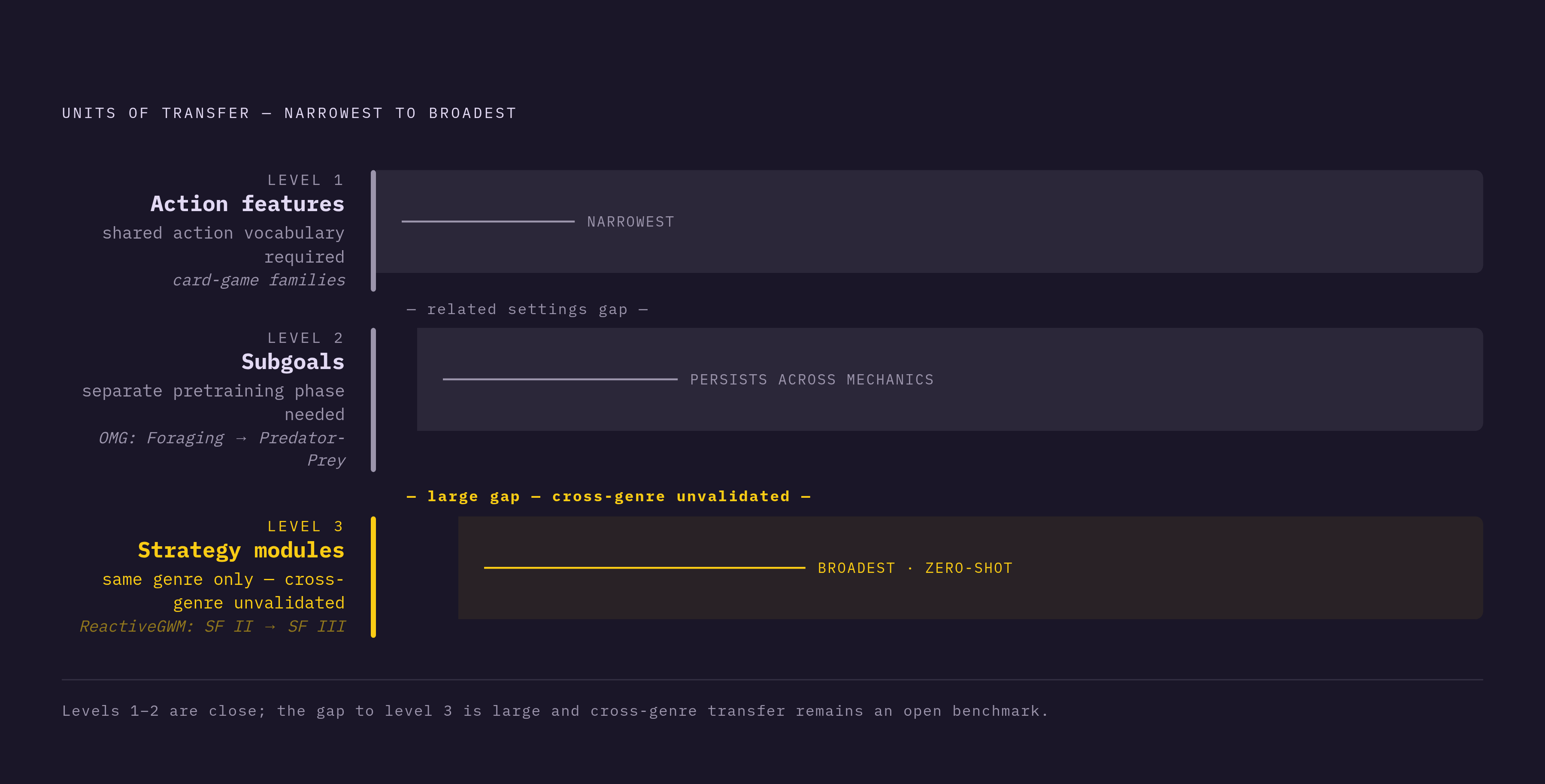
For researchers and engineers, the practical decision is which behavioral object should survive the change of game. Action-level features may suffice within card game families that share an action vocabulary. Subgoals offer an intermediate level where task structure persists despite changes in mechanics. Strategy modules seek a broader separation from game-specific encoding and are likely required for cross-genre transfer. These choices entail different architectural commitments.
StratFormer provides action-level conditioning within a single poker variant, while its cross-variant scope remains untested. OMG demonstrates subgoal inference across related task settings with environment-specific preparation. The abstraction should be chosen against the intended target domain, while behavioral inference and exploitation should be trained jointly so that a portable estimate does not become unusable at the policy boundary.
A benchmark spanning genuinely different action vocabularies and reward structures is the unresolved requirement. It would allow action, subgoal, and strategy-module representations to be compared under the same transfer demand, including the tradeoffs between training-time abstraction and test-time adaptation. The survey identifies the distinction between artifact reuse and validated capability transfer as a central challenge at foundation-model scale. That distinction sets the standard for opponent modeling as well. The hard case remains demonstrating useful behavioral inference and response after both the language of action and the structure of reward have changed.
Sources
- StratFormer: Adaptive Opponent Modeling and Exploitation in Imperfect-Information Games
- StratFormer: Adaptive Opponent Modeling and Exploitation ...
Provided the description of StratFormer's architecture, including dual-turn tokens, curriculum phases, bucket-rate features, and the gap between modeling and exploitation pipelines.
- [2508.17671] Consistent Opponent Modeling in Imperfect-Information Games
Provided the basis for the discussion of Ganzfried's consistency result for opponent modeling in imperfect-information games.
- AI for Games in the Foundation Model Era
Provided the NUS/NTU survey framing on setting-specific state representations and the validation requirement for capability transfer at foundation-model scale.
- Opponent Modeling based on Subgoal Inference Xiaopeng Yu Jiechuan Jiang
Provided the description of OMG's subgoal-inference approach, its compositional property, and its evaluation on Foraging and Predator-Prey tasks.
- Combining Deep Reinforcement Learning and Search with Generative Models for
Provided the description of CEO-Poker's five-component modular architecture and its meta-controller that switches between equilibrium and exploitative play.
- Opponent Modeling with In-context Search
Provided the description of OMIS's pretrained in-context components for decision-time search, its theoretical improvement guarantees, and stable performance against non-stationary opponents.
- ReactiveGWM: Steering NPC in Reactive Game World Models
Provided the description of ReactiveGWM's architecture, its zero-shot transfer from Street Fighter II to Street Fighter III, and the mechanism separating NPC strategy from the diffusion backbone.