Meta-Learning From Diverse Game Tasks for Rapid Adaptation
Task diversity during training teaches agents which patterns transfer and which don't.
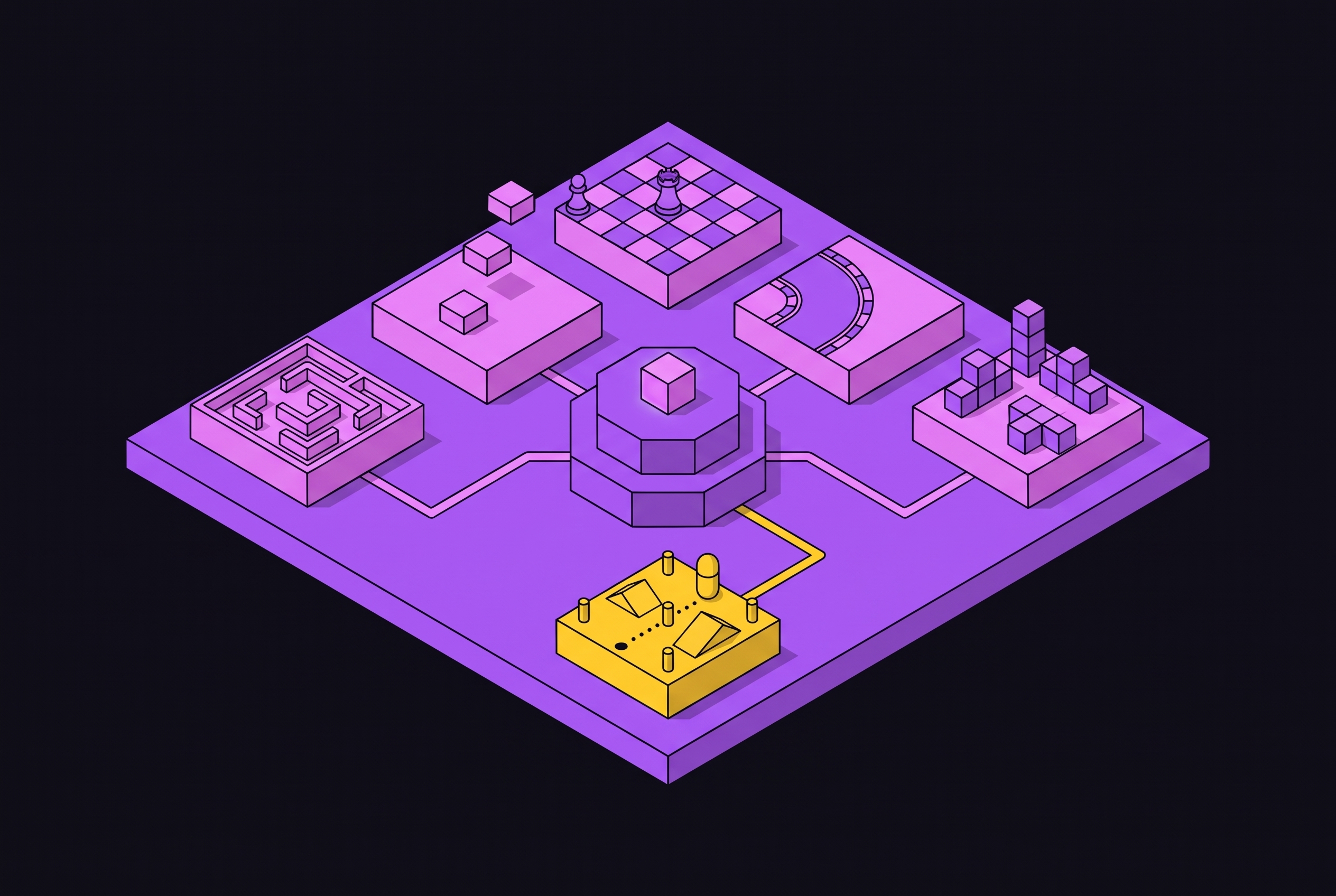
Meta-learning from a wide range of game tasks aims to improve performance on familiar games and make the next environment cheaper to learn. Its central mechanism is task diversity. Training across different dynamics, reward structures and strategic settings builds transferable priors that help the agent adapt quickly, if the training distribution covers the kinds of change it will face and the agent can spot them with little experience.
Why training across many game tasks is not just a design choice but the mechanism that enables rapid adaptation
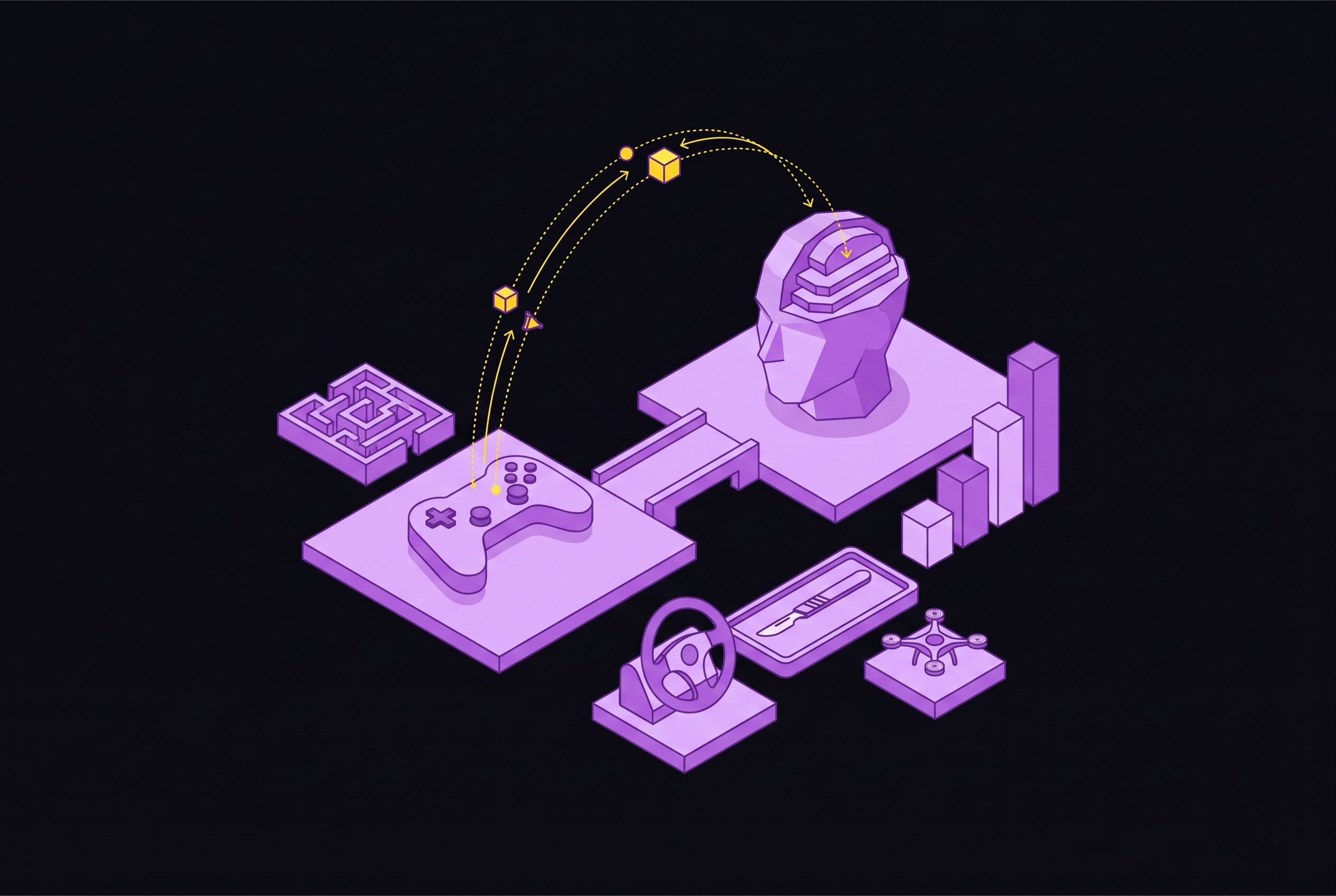
Learning a task and learning to learn have different engineering goals. The first produces an agent that solves a particular environment. The second seeks to reduce the data, computation or interaction required to solve the next one. An agent trained on a single task has little reason to separate reusable structure from features peculiar to that task. Across a wide distribution, however, an agent can adapt only if it recognizes what changes and what it can reuse.
That distinction makes task diversity more consequential than the choice of algorithm family. Shared knowledge can transfer broadly only if training exposes the agent to sufficiently varied and representative tasks. Games provide such variation through partial observability, stochasticity, multi-agent interaction, procedurally varied mechanics and sparse or delayed rewards. These differences change what an agent must infer. A useful prior therefore concerns not just which action worked before, but how to recognize the conditions under which that action will work again.
What meta-RL actually does without losing sight of the task distribution
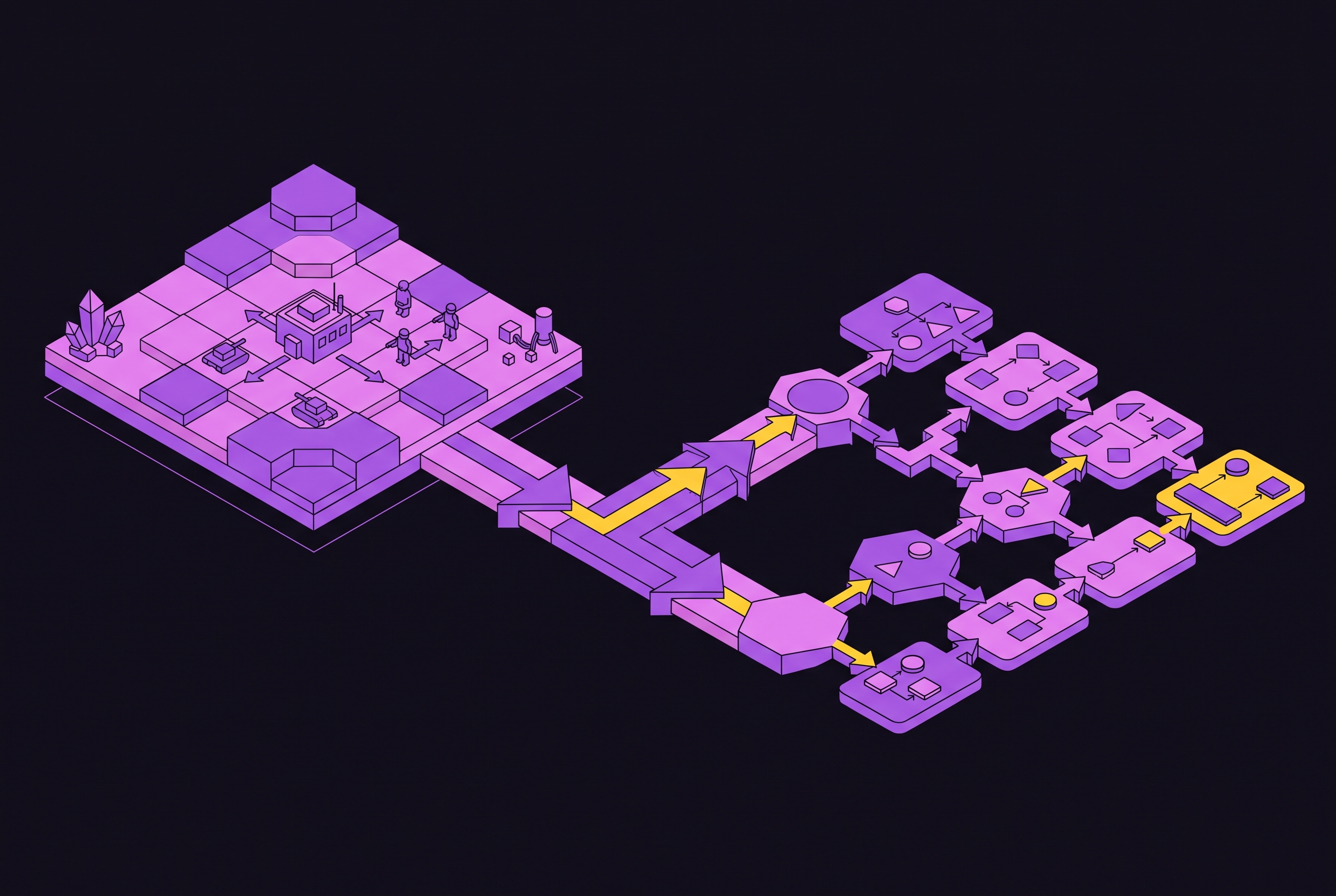
Meta-reinforcement learning formalizes this objective through a distribution of tasks, represented as sequential decision processes, and two linked learning loops. The outer loop updates the parameters that a batch of tasks share. The inner loop adapts to a single task using a small number of interactions. In gradient-based methods, this means adapting a copy of the shared parameters. At test time, that task-specific process is where rapid adaptation occurs.
The architecture determines how adaptation is implemented. MAML and its variants learn an initialization that becomes effective after a few gradient steps on a new task. Recurrence-based methods such as RL² instead encode task history in a hidden state, allowing memory to implement a learned reinforcement learning algorithm without explicit weight updates. Memory-Augmented Neural Networks, or MANNs, achieve rapid learning through external memory operations that link inputs to outcomes and look them up later. Despite those differences, each family is shaped by the tasks presented during meta-training, so the distribution determines which regularities its adaptation process can learn.
Why games are a demanding proving ground for meta-RL claims
Games test whether those regularities survive changes that defeat simple reuse. Partial observability limits what the agent can learn from an interaction, while stochasticity makes outcomes harder to make sense of. Sparse or delayed rewards complicate the link between an action and its value. Procedurally varied mechanics add another source of uncertainty. In multi-agent games, the learner must also infer other agents’ strategies while the environment may be changing through their adaptation.
The Procgen benchmark makes one consequence visible. Agents trained on a narrow set of levels can have high training returns yet do poorly on procedurally generated levels they have never seen. High performance on familiar environments therefore does not establish that an agent has learned to adapt. Purdue University’s HyPE research exposes a subtler obstacle through a natural language Alchemy game. Tasks share an action space and surface structure but differ in latent dynamics, including which potion changes which stone. Here, unfamiliarity is not visible from the task’s appearance, and the agent must probe the environment to distinguish it from previously encountered tasks.
How passive exploration wastes the adaptation budget and what active task identification achieves instead
Random actions can use up an adaptation budget while leaving the agent unsure about the task. This happens when informative transitions are rare or require specific behaviors. Passive exploration then delays identification of the previously learned model that best fits the new environment. Diversity alone cannot solve that inference problem. The agent also needs an efficient way to draw on its accumulated knowledge.
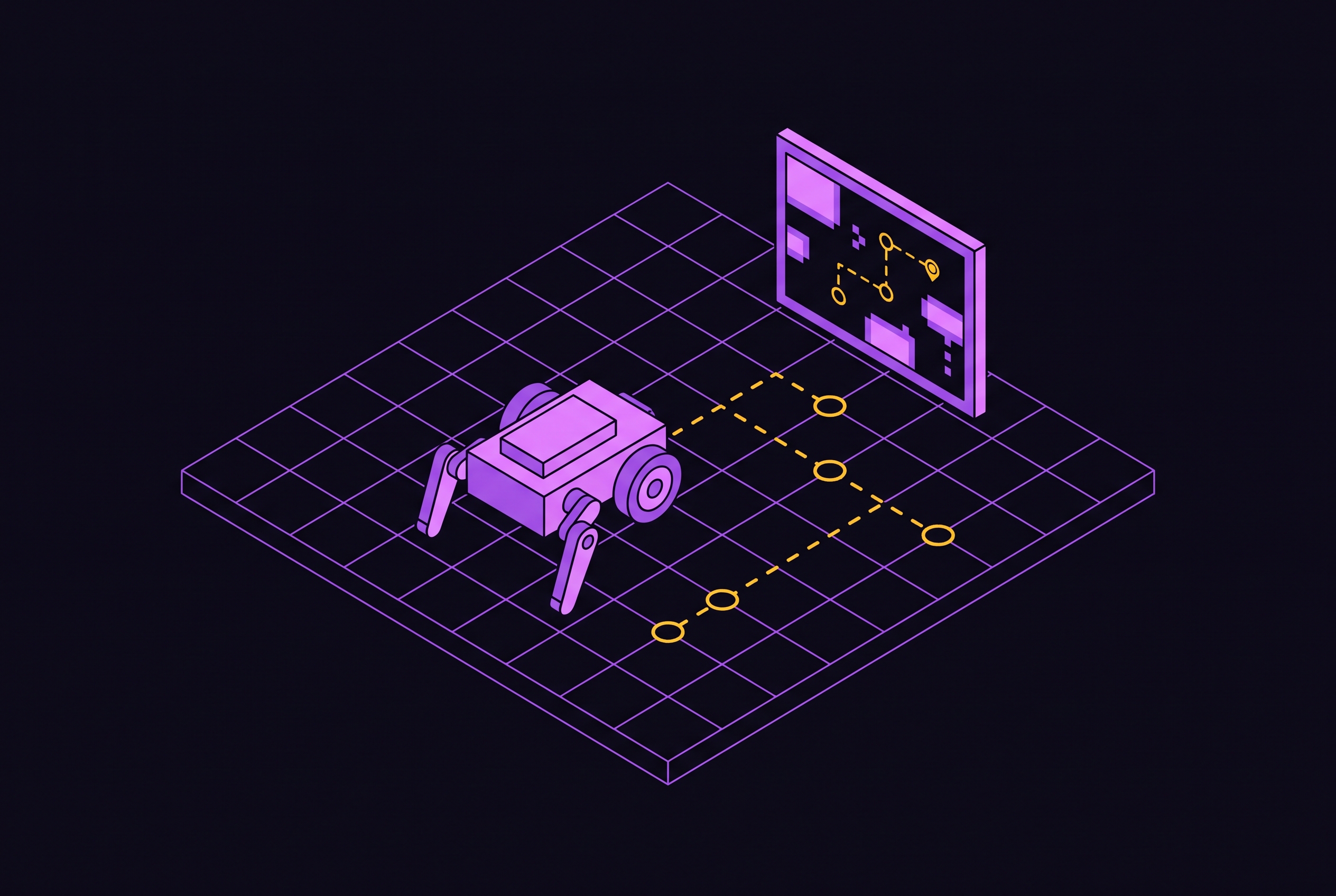
HyPE, or Hypothesis-Planned Exploration, addresses this problem through active hypothesis testing. It maintains candidate dynamics models from meta-training and plans actions that reduce uncertainty about which model fits the current task. In a joint latent space, transitions from different tasks form distinct paths, so a sequence can distinguish models even when no single transition is decisive. The HyPE paper reports that the method identified the closest task in 65–75% of trials on the natural language Alchemy game, outperforming passive exploration under the same sample budget. Planned identification is useful only when the pool contains a model genuinely close to the new task.
What happens when the training task distribution is too narrow or poorly designed
Coverage cannot be inferred from the number of tasks alone. The NeurIPS 2022 diversity coefficient work found low task diversity in popular benchmarks including MiniImageNet and CIFAR-FS. In fair comparisons on those low-diversity benchmarks, MAML and transfer learning had the same meta-test performance. These are image benchmarks. Separately, a NeurIPS 2022 study comparing fine-tuning and meta-reinforcement learning found that meta-RL offered no advantage over multi-task pre-training on generalization to complex visual tasks such as Atari games.
Those findings make distribution design an engineering problem. Meta-learning earns its added cost only when it meets adaptation needs that ordinary pre-training and fine-tuning cannot meet. Simple uniform priors over task identifiers and hand-crafted distributions can still omit critical scenarios. The Tsinghua University team’s KDD’25 adversarial task distribution paper offers a constructive response. Its method models the task distribution as an adversary and uses normalizing flows to shift training toward worst-case scenarios, improving robustness to task subpopulation shifts. The objective is not indiscriminate variety, but exposure to the differences that reveal weaknesses in adaptation.
How training across structurally diverse game-theoretic settings builds transferable strategic priors in multi-agent games
Multi-agent non-stationarity intensifies the variation exposed by procedural generation. In a single-agent setting, unfamiliar mechanics already demand inference. When other agents also adapt, the learner faces changing strategies as well as potentially unknown game structure and parameters. The learner must use early interactions to learn about both. A prior that assumes a fixed strategic setting can therefore become a liability.
The self-play meta-RL paper published by Springer studies distributions of normal-form games whose parameters are payoff matrices and which include both coordination and zero-sum structures. It reports sample-efficient agents that remain robust to game-type changes and generalize strategically across distinct structures. Coordination and zero-sum games require fundamentally different strategies, so training across both forces the learner to infer structure from payoff signals. That inference is the transferable strategic prior. Self-play gives the learner opponents that behave in different ways across the game distribution, so robust joint policies can develop without a hand-designed opponent curriculum. Task diversity thus includes not only the rules of the game, but the adaptive behavior encountered within them.
The two failure modes that pull against each other
Catastrophic forgetting happens when updates for a new task overwrite the weight configurations that earlier tasks need, especially when their representations conflict. Negative transfer runs in the other direction. Knowledge kept from earlier tasks can hurt performance on a new task it fits poorly, leaving the agent worse off than if it had learned from scratch. Prior work in continual reinforcement learning has focused heavily on forgetting, but protecting old knowledge alone does not prevent harmful reuse.
FAME, or Fast And Meta knowlEdge learners, targets both failures through a dual-learner framework inspired by hippocampal–cortical interaction. Teams from the University of Alberta, Chinese Academy of Sciences and Huawei published it at ICLR 2026. Its fast learner transfers knowledge through an adaptive meta warm-up that either copies parameters or uses behavior cloning regularization to guide exploration. Its meta learner integrates new knowledge while explicitly minimizing catastrophic forgetting, rather than simply maximizing average return across tasks. The FAME paper reports better average performance and forward transfer than all baselines on two separate Atari sequences, one comprising SpaceInvaders modes and the other Freeway modes.
What DiscoRL shows about the reach of diversity-driven meta-training
DiscoRL moves the diversity argument from adaptable policies to learned update rules. Google DeepMind published the system in Nature in October 2025, demonstrating a reinforcement learning rule that generalizes zero-shot to environments outside its discovery training and surpasses manually designed algorithms in generality and efficiency. During discovery, a population of agents interacts with separate instances drawn from a diverse task set. Meta-gradients improve the update rule based on how well the agents do across that distribution. This is the outer-loop principle applied to the learning algorithm itself.
The training scope distinguishes the discovered rules. Disco57 was meta-trained on 57 Atari games, while Disco103 used 103 environments spanning Atari, ProcGen and DMLab-30. The stronger evidence is transfer to unseen benchmarks, where the rule works without further meta-training. DiscoRL also discovered prediction semantics distinct from established concepts such as value functions, suggesting novel algorithmic structure rather than only a recombination of familiar components. Although the original discovery campaign’s scale creates a practical constraint, its cross-benchmark transfer shows that diversity can shape both how an agent learns and how it plays.
Where task-distribution shift at test time still breaks meta-learned agents
Zero-shot transfer can still fail when the structure changes. A genuinely broad training distribution can still omit the feature that defines a new environment. Discontinuous shifts in genre, mechanics or reward scale expose this boundary sharply in games. This is distinct from low training diversity.
That distinction also limits what task identification can accomplish. An agent may efficiently compare familiar models without finding one that captures the new environment’s structure. The earlier adversarial distribution work addresses part of this risk by making worst-case task scenarios a training target and testing robustness to subpopulation shifts before deployment. It does not establish coverage of every possible novelty.
How algorithm self-discovery and LLM-generated update rules extend the diversity argument beyond existing benchmarks
Algorithm self-discovery at scale and online discovery of update rules using LLMs as code generators let the search go beyond designs tied to existing benchmarks. The developments described for 2025–2026 broaden what can be learned, rather than only increasing the number of environments used for training. LLM-generated rules open a search space of describable algorithms instead of restricting discovery to parameterizable architectures. That is a potential route to adaptation to unrepresented game genres, with success still unestablished.
In practice, task distribution design needs attention before a change in algorithm family can be expected to make up for narrow experience. Its breadth, structural variety and coverage of worst-case scenarios determine what shared knowledge has a chance to become useful. MAML’s initialization, recurrent memory, self-play strategic priors and discovered update rules differ in implementation, but each draws its adaptability from variation encountered during learning. The forward opportunity is to expand both that variation and the space of learning rules shaped by it. Rapid adaptation advances when training exposes the distinctions the next task will require the agent to recognize.
Sources
- Hypothesis Network Planned Exploration for Rapid Meta-Reinforcement Learning Adaptation
Provided details on the HyPE hypothesis-planned exploration method and its 65–75% task identification results on the natural language Alchemy game.
- Robust Fast Adaptation from Adversarially Explicit Task Distribution Generation
Provided details on the adversarial task distribution method using normalizing flows to shift training toward worst-case scenarios.
- Published as a conference paper at ICLR 2026
Provided details on the FAME dual-learner framework, its hippocampal–cortical inspiration, and its reported results on Atari game sequences.
- Self-Play Meta-Reinforcement Learning in Multi-Agent Games
Provided details on the self-play meta-RL study of normal-form games with coordination and zero-sum structures and its sample-efficiency findings.
- Disentangling Transfer in Continual Reinforcement Learning
Informed the discussion of catastrophic forgetting and negative transfer as dual failure modes in continual reinforcement learning.
- 1 A Survey of Deep Reinforcement Learning in Video Games
Provided background on deep reinforcement learning in video games, including Atari benchmarks and procedural generation challenges.