Self-Play Dynamics in Competitive Game Training Regimes
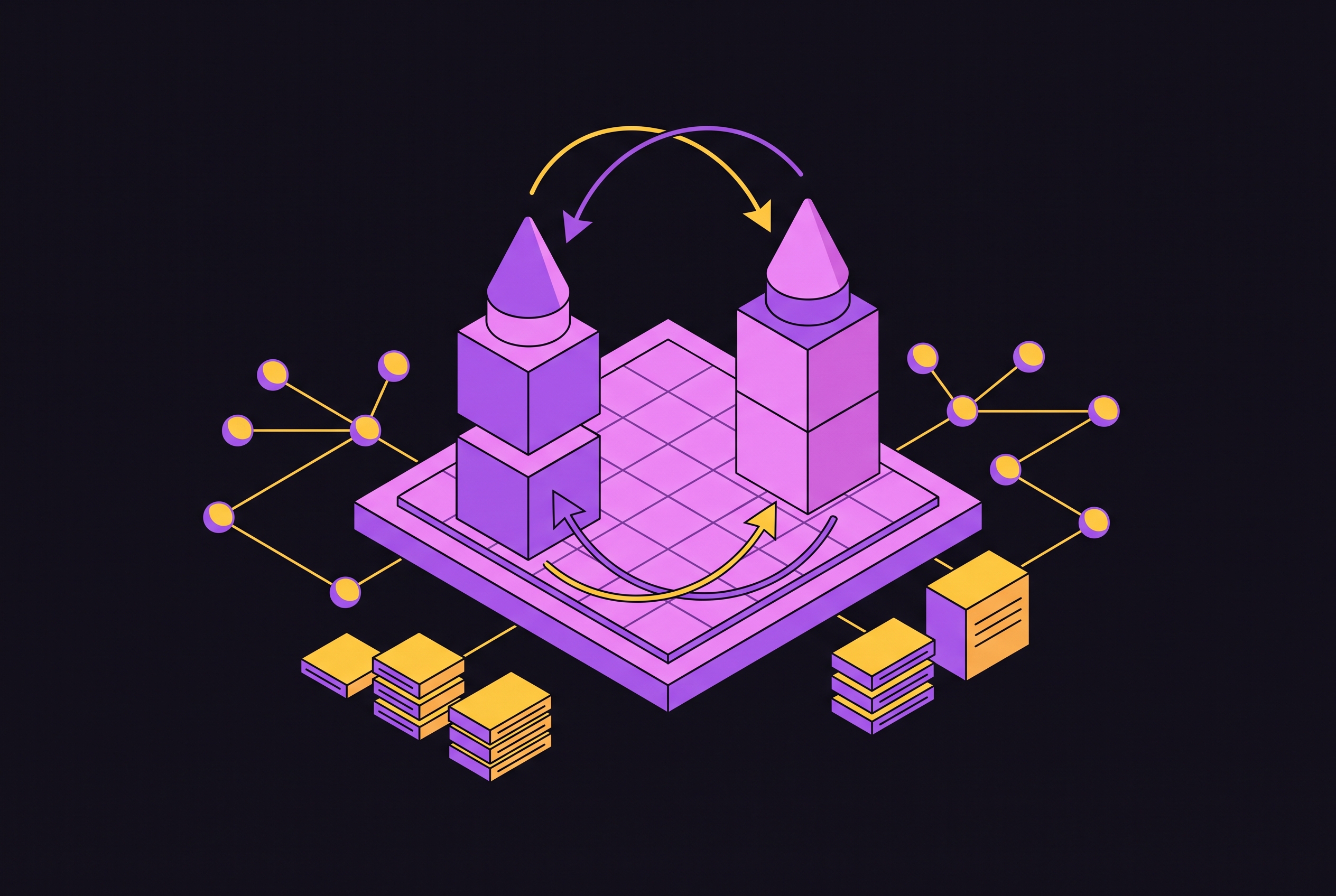
Self-play training regimes get their power from one mechanism: the opponent improves at exactly the same rate as the agent, because the opponent is the agent. That single fact explains why the method has produced some of the most significant results in artificial intelligence over the past three decades, and it explains why the same method keeps running into predictable trouble when the game's structure changes shape.
Why self-play produces a self-scaling training curriculum
An agent trained through self-play never runs out of challenge, because the challenge is manufactured by its own progress. The opponent gets harder on its own, because it is a copy, or a near-copy, of the agent from a few training steps back. This has a clean grounding in game theory: self-play is a Monte Carlo version of fictitious self-play, a process that approximates a Nash Equilibrium over time. Once a version of the opponent gets sampled, it can be treated as a fixed part of the environment, and that means ordinary single-agent reinforcement learning algorithms, the kind built to find the best response to a fixed environment, can do the job of solving the game.
The setup works best in two-player, zero-sum games where both players can see the whole board. AlphaGo brought it to superhuman performance in Go in 2016, and AlphaZero carried the same approach into Chess and Shogi across 2017 and 2018. OpenAI Five then pushed the method into a real-time strategy game between 2018 and 2019, proving the curriculum-generation trick could survive contact with a far messier action space than a board game offers.
Three structural pathologies that undercut naive self-play
The scaling curriculum does not guarantee that training converges to anything useful, and three specific failure patterns appear once the game gets complicated enough, the first being cycling. Naive self-play can spin through such a cycle indefinitely without settling anywhere close to a Nash Equilibrium with good worst-case guarantees, because each new agent is simply tuned to beat whatever it played against most recently, not to handle the full space of possible strategies.
The second pathology is forgetting. The third pathology is homogenization, a narrowing of strategic diversity that happens when every agent in the loop is descended from the same small set of ancestors. These three problems are not separate accidents. Cycling is a failure to converge, forgetting is a failure of memory, and homogenization is a failure of diversity, and while each one needs its own fix, the fixes do not sit independently of each other: a remedy for one can make another worse.
How population-based training addresses cycling and diversity
Population-Based Training answers these problems by changing the unit of training from a single agent to a population of agents trained in parallel. This is more than a tuning adjustment. A single self-play agent, trained alone, has no built-in reason to maintain strategic variety, so there's no guarantee that it will stay robust against strategies it rarely encounters during its own training. A population changes that by letting different members explore different strategic lines at the same time, which produces a final policy, or a final roster of policies, that holds up against a wider range of play.
Even so, population size alone does not fully solve diversity. And population methods are not free. Compute cost rises with the size of the population being trained, and the AlphaStar training run stands as the clearest evidence that industrial-scale computing resources were, for years, treated as the entry price for running a league-based self-play system in any game of real complexity.
What Ataraxos reveals about imperfect-information games and training efficiency
A 2026 result in Stratego breaks that assumption. The system, called Ataraxos, shows that the efficiency gains available to self-play were nowhere near tapped out, and that a smarter algorithm can reach superhuman performance in a game with hidden information for a tiny fraction of what earlier systems spent to get there. Stratego hides piece identities until two pieces collide on the board, and the number of possible piece arrangements exceeds 10 to the 66th power, a search space that dwarfs chess. As Gabriele Farina put it to MIT News, "AI techniques that were developed for games like poker definitely could not scale in this setting."
Ataraxos was built by a team drawn from Carnegie Mellon, MIT, Stanford, and NYU, and the results were published in Nature on September 30, 2026. Across the wider championship-level test set, its record stayed close to perfect, marking the first superhuman result in the game's history. The mechanism behind that result pairs two self-play processes: one learns the blueprint strategy for setting up pieces before play begins, and the other handles move-making during the game, with decision-time planning layered on top. Transformer networks paired with a technique called dynamic damping let the system learn quickly without getting stuck trying to track every possible hidden arrangement of the board.
The cost difference reframes the whole conversation. A result that once required an industrial lab's budget now fits inside a cost a small research group could cover. In imperfect-information games, the lesson running through Ataraxos is that how the self-play loop is built, the split between blueprint learning and decision-time planning, does more work than how much compute gets thrown at the problem.
Where self-play's pattern-learning breaks down: the Nim case
Self-play's curriculum is only as good as what the agent can actually learn from the raw positions it sees, and there is a game where that learning breaks down cleanly and measurably. Søren Riis, of Queen Mary University of London, studied AlphaZero-style self-play applied to Nim, a matchstick game played by children that has a complete, known mathematical solution. His research found that agents trained this way play competently on small boards, but their performance degrades sharply as the board grows, with predictions drifting toward random guessing at larger sizes.
What makes Nim useful as a test case is that the right move is known for every single position on the board. Bei Zhou and Riis state the finding in their conclusion: "impressive performance alone is not proof that a system has learned the underlying principle. Closing the gap, in their view, requires analytic representations or hybrid methods that go beyond what raw self-play supplies on its own.
The Nim result does not contradict what Ataraxos demonstrated. The two sit on opposite sides of a dividing line. Stratego's difficulty is positional and strategic, the exact kind of complexity that blueprint learning through self-play is built to handle. Nim's difficulty is mathematical, requiring an abstract structure that the self-play loop, built around pattern recognition over raw positions, has no mechanism to generate on its own.
The multi-agent coordination problem: when teammates, not opponents, are the challenge
Two-player zero-sum theory has nothing to say about games where some of the other agents on the field are supposed to be helping you instead of beating you, and that is exactly the situation multi-agent settings with both cooperation and competition create. Agents in these environments need to build shared conventions with teammates, not simply compute a best response to an opponent, and self-play trained in isolation tends to settle on conventions that make perfect sense internally but look baffling to a human teammate dropped into the same system.
TiZero, presented at AAMAS 2023, took on the full 11-versus-11 Google Research Football environment, a setting that combines cooperation among teammates, competition against the opposing team, sparse rewards, non-transitive strategic relationships, and unpredictable transitions all at once. The adaptive curriculum solves a version of the forgetting and wasted-effort problem described earlier, tuning the difficulty of what the agents face so training time isn't spent on matchups too easy or too hard to teach anything. The joint policy objective solves a different problem: without it, standard self-play optimizes each agent on its own, and that can produce teammates running the same algorithm who still fail to coordinate with each other.
A separate research direction, self-play meta-reinforcement learning, tackles multi-agent settings where the structure of the game itself isn't known in advance or keeps shifting. This line of work remains a proof of concept rather than a deployed system, and it addresses a different problem than TiZero does: TiZero is an engineering answer to a known coordination challenge in a fixed environment, while meta-RL is a research answer to the harder question of adapting when the rules themselves are unknown. What both share is a weakness that traces back to self-play's basic design: because the method has no human demonstrations anchoring it, it has no built-in way to tie the conventions it invents to anything a human partner would recognize.
The robustness gap: how self-play training distributions create exploitable blind spots
Self-play produces strategies that dominate within the range of situations the agent actually encountered during training, but it leaves rare situations underexplored, and that gap can be found and exploited by an opponent that is not even stronger than the trained agent, only better targeted, a vulnerability that is not hypothetical. Targeted self-play strategies have defeated superhuman Go systems, including KataGo, by finding and exploiting exactly these blind spots, proving that a self-play champion can lose to a deliberately constructed weaker opponent that knows where to look.
What self-play optimizes for builds in this brittleness. In Nim, that brittleness can be measured precisely across the whole state space, while in Go, it has to be discovered by an adversary before anyone knows it's there to find.
A 2025 study of co-adaptation under constraint adds a further wrinkle: agents trained under self-play collapsed more severely when facing a co-adapting opponent than when facing a fixed, static Nash-equilibrium opponent, suggesting that the mutual back-and-forth between two learning agents can amplify blind spots. The fair counter is that no self-play regime so far has demonstrated anything close to a coverage guarantee for the rare, low-probability states where these failures tend to hide.
What transfers when self-play migrates into language model training
Self-play's move into training large language models is its biggest expansion yet, and the game-theoretic foundation that makes self-play work so well in competitive games starts to crack under the demands of open-ended text generation. Researchers are now reframing reinforcement learning from human feedback as a game-theoretic process in its own right, treating self-play as a serious method for alignment work across domains beyond games.
New problems specific to language generation have already appeared in this transition. Tree-like Self-Play, presented at ICML 2026 in Seoul, applies the adversarial structure of self-play to secure code generation: the model produces both a secure "golden path" and vulnerable variants at key decision points, treating its own flawed branches as the opponent to train against. That shows self-play's core adversarial idea can be rebuilt at the level of individual tokens and decision forks rather than only at the level of a finished game outcome.
What doesn't carry over cleanly is the theoretical anchor. Competitive games have a Nash Equilibrium sitting at the center of the theory, giving self-play a concrete target to converge toward. Open-ended language generation has no settled equivalent, and whether equilibrium framing even applies in a meaningful way to language tasks remains genuinely contested among researchers. Whether the field's hard-won intuitions about population diversity, historical opponent mixing, and convergence monitoring hold up in language model training is still an open question being worked out in real time.
Design decisions every serious self-play training regime must make
There is no single best-practice checklist that applies to every self-play system, because the right design choice in each area depends on the specific shape of the game being trained on, and the problems laid out across this piece point to where those choices actually have to be made. Opponent sampling is the first decision: pure self-play against only the latest version of the agent tends to cycle, a lightweight historical mix like the one OpenAI Five used is a cheap partial fix, and a more principled approach like AlphaStar's Prioritized Fictitious Self-Play costs more compute but handles non-transitivity more carefully, so the right pick depends on how cyclical the game's strategy space turns out to be. Whether to train a single agent or a population is the second decision, and here a single agent offers no guarantee of strategic diversity, while a population or a full league buys robustness at a compute cost that the Ataraxos result suggests can be brought down through better algorithms.
The presence or absence of hidden information is the third decision point, since standard self-play has no built-in way to reason over information that one player can see and the other cannot, and that forces a different architecture, whether that means the dual blueprint-and-planning structure Ataraxos used or a league-style structure built around Prioritized Fictitious Self-Play. And the sixth decision is recognizing, before committing significant compute, whether the game in question depends on abstract arithmetic or logical structure over positional pattern, since the Nim research shows that games built on this kind of abstraction need hybrid methods built around analytic representations or external solvers in place of a pure self-play approach.
Across chess and Go, Stratego, football simulations, and now language models, the engine doing the work is the same one described at the start: an opponent that gets harder exactly as fast as the agent improves. The frontier that remains open is the language model domain, where that engine is being bolted onto a problem whose geometry nobody has fully mapped yet, and where the design decisions that took three decades to work out for games are still being written from scratch.
Sources
- This game-playing AI is the new champ at Stratego
Provided details on the Ataraxos system, its superhuman Stratego result, the quote from Gabriele Farina, and the Nature publication date.
- Learn from Your Mistakes: Tree-like Self-Play for Secure Code LLMs
Provided details on Tree-like Self-Play for secure code generation presented at ICML 2026.
- TiZero: Mastering Multi-Agent Football with Curriculum Learning and Self-Play
Provided details on TiZero's curriculum learning and joint policy objective in the 11v11 football environment.
- A Structural Threshold in Decision Capacity Governs Collapse in Self-Play Reinforcement Learning
Provided the 2025 finding that agents under self-play collapsed more severely against co-adapting opponents than against static Nash-equilibrium opponents.
- Self-Play Meta-Reinforcement Learning in Multi-Agent Games
Provided the basis for the discussion of self-play meta-reinforcement learning in multi-agent settings with unknown or shifting game structures.
- Superhuman AI for Stratego Using Self-Play Reinforcement Learning and Test-Time Search
Provided technical details on the Ataraxos architecture, including the dual blueprint-and-planning structure, transformer networks, and dynamic damping.
- AI’s game-playing still has flaws, research shows - Queen Mary University of London
Provided context for Søren Riis's and Bei Zhou's research on AlphaZero-style self-play applied to Nim and its failure to generalise to larger boards.
- Impartial Games: A Challenge for Reinforcement Learning
Provided the core research findings on impartial games like Nim as a challenge for self-play reinforcement learning, including performance degradation at larger board sizes.