Offline RL vs Online RL Tradeoffs for Fixed Game Datasets
Offline RL requires tight data coverage; online RL tolerates gaps by learning from mistakes.

A fixed game dataset is a closed record of interactions, collected once, with no further access to the environment once training begins. Whether offline reinforcement learning or online reinforcement learning is the right tool for a given game project comes down to that single fact, more than any choice of algorithm.
What makes a game dataset "fixed
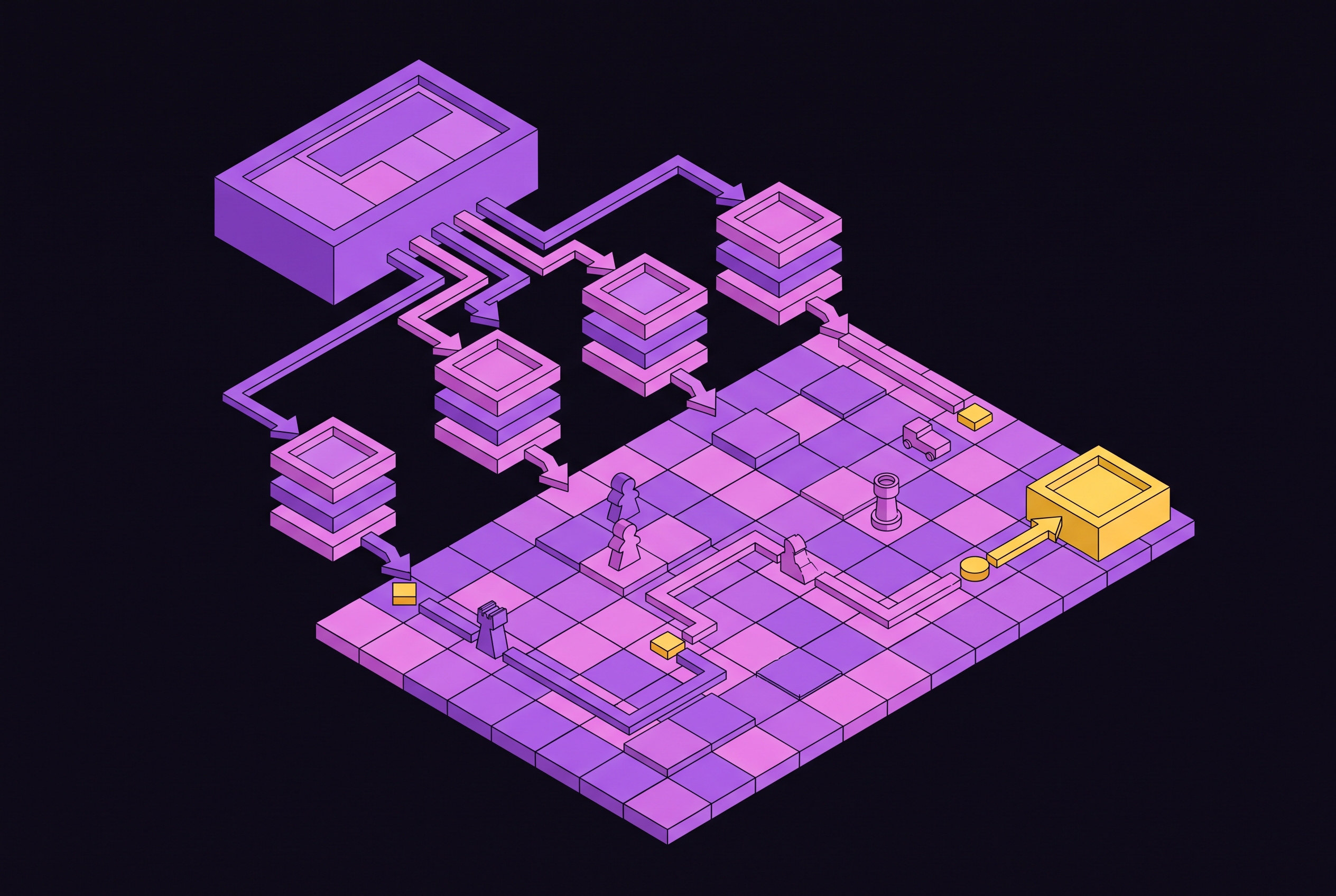
Online RL rests on a loop: a policy acts, the environment responds, and that response feeds back into the next round of optimization. Ericsson's explainer on reinforcement learning describes offline RL by what's missing from that loop. Learning happens entirely from logs that were recorded before training ever started. That absence is what the word "fixed" is pointing to. It isn't a comment on dataset size or age: the agent cannot correct its own mistakes by trying something and watching what happens, because trying something new isn't on the table.
In games, this condition appears in a handful of concrete forms: human replay archives pulled from a live title, logs from a past competition, a one-time data collection campaign run against a build that no longer exists, or a simulator so expensive to run that querying it during training is a non-starter. The quality, diversity, and coverage of that original behavior policy becomes the ceiling and the floor of everything built on top of it.
Because the dataset is fixed, the first question a practitioner has to ask isn't which algorithm is newest or best-performing on a leaderboard. Every tradeoff discussed in this piece, between pessimism and coverage, between staying offline and buying a little online access, traces back to that one question.
Distributional Shift as the Defining Problem for a Fixed Dataset
Distributional shift is the structural cost of learning from data that was collected by somebody else, under some other policy, at some other time. Any policy a practitioner trains will, sooner or later, want to take actions or visit states that the original behavior policy never visited. At that point, the value function has nothing to go on, and it extrapolates, often badly, into territory the data never described.
Standard Q-learning breaks down here in a specific, well-documented way: the Bellman operator exploits overestimated Q-values for out-of-distribution state-action pairs. The policy then steers toward exactly the areas it should avoid, because those areas look artificially attractive on paper.
Online RL has a built-in corrective: a bad rollout generates a bad reward, and the next round of data collection reflects that. Offline RL has no such feedback loop. Once the model commits to an inflated estimate, the error compounds instead of correcting, since nothing in the fixed dataset can push back on it. Chen et al., testing across 31 environments, trace a large share of offline performance degradation to exactly this mechanism: out-of-distribution states encountered at test time, driven by limited state-space coverage in the training data, which produces a mismatch between what the agent expects to happen and what the environment actually does. The severity of distributional shift, in other words, is set almost entirely by what the data covers, not by which algorithm processes it.
Data Coverage and the Cost of Distributional Shift
Coverage, not dataset size, is the number that predicts how much trouble a practitioner is in. Chen et al. make this point directly: adding exploration data to a collection effort measurably reduces offline performance degradation, and they note that most current data collection efforts lean almost entirely on expert play, leaving this lever unused.
The tradeoff runs in both directions. A broader or more random dataset covers more of the state space but drags along noisier, lower-quality action labels, since the policy that generated it wasn't trying to play well.
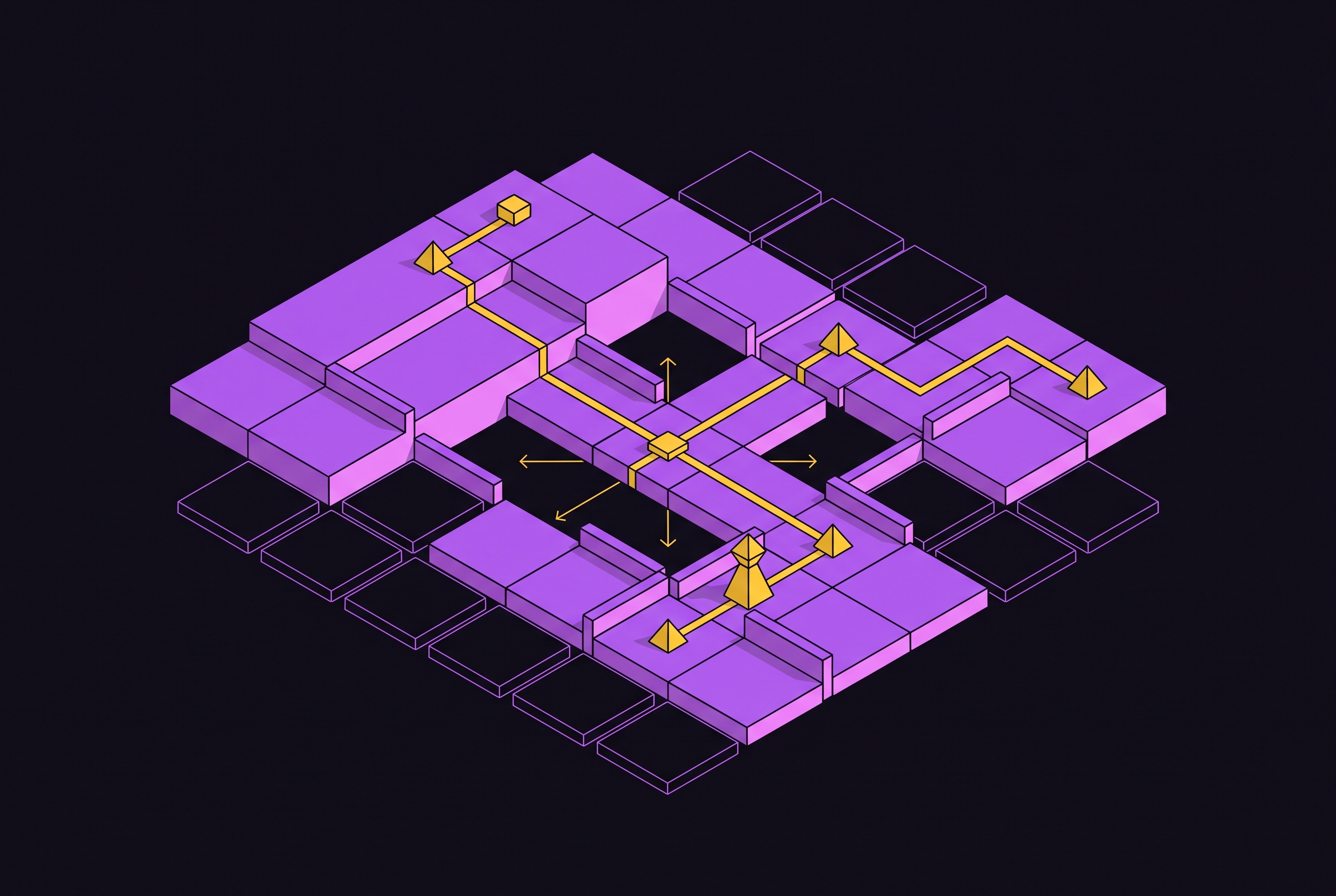
Game datasets often resist this binary. A human replay archive is neither consistently exploratory nor consistently expert. Offline datasets of this kind effectively contain several latent distributions stitched together: data from different players following different strategies, and data from the same player whose behavior shifts across different phases of a match. Standard offline algorithms don't model that internal structure; they treat the dataset as if it came from one source.
Before picking an algorithm, a practitioner needs a coverage audit: a direct check of what states and actions the data actually represents, set against what states and actions the deployed policy is likely to encounter. The point is that coverage, confirmed before training, is the variable that determines how expensive distributional shift turns out to be.
What Pessimism-Based Offline RL Methods Trade Away
The standard response to distributional shift is pessimism: keep the learned policy close to known territory, and penalize or forbid anything that looks unfamiliar. Policy-constraint methods hold the learned policy near the behavior policy that generated the data, cutting down on extrapolation error. Conservative Q-function methods take a different route to a similar place, penalizing Q-values assigned to out-of-distribution actions. Both approaches work by tying the learned policy to the quality of whatever policy produced the data in the first place.
That tie is the cost. A human replay archive from a competitive game usually spans a wide range of skill, and a pessimistic method trained on it risks locking the resulting agent to something close to the median player's level, below the best play on record.
Algorithm choice within pessimism still matters. But even the strongest pessimism method in that comparison was still bounded by the quality of the dataset it trained on. Pessimism is a tool for managing a known risk, not a substitute for finding out what the risk is.
The gap between benchmark assumptions and real fixed datasets
Three game benchmarks show what the coverage gap costs in practice. Hokoff, built by researchers at Tsinghua University and Tencent and presented at NeurIPS 2023, uses a large pre-collected dataset drawn from Honor of Kings, a MOBA with dense strategic interaction between players. No fixed human-play archive is built with that requirement in mind, so none of them satisfy it.
Metamon, built at UT Austin and presented at RLC 2025, tells a different part of the story. The dataset wasn't broad enough to carry the agent further on its own.
The racing game benchmark (arxiv:2407.09415) contributes the algorithm-selection lesson.
The broader benchmark suites underline why these three cases matter. D4RL and RL Unplugged, the two most widely used offline RL benchmark suites, lean toward relatively simple tasks and mostly skip multi-agent settings; RL Unplugged does include some high-dimensional observation tasks, but neither suite reflects the complexity of real deployment. The standard benchmarks don't model the coverage failures that Hokoff, Metamon, and the racing game study each expose in their own way, and that gap is what makes the hybrid strategies discussed next worth taking seriously.
When online interaction is not truly unavailable
"Fixed dataset" describes the training data a project starts with. It rarely describes an absolute wall against any environment access whatsoever. What a single additional query to the environment would actually cost matters more than treating offline versus online as a binary choice. In games that cost varies enormously: a simulator might be cheap to run once it's set up but expensive to configure; a replay environment might exist but lack the instrumentation RL training needs; a competitive multiplayer title might carry hard API rate limits or matchmaking constraints that make live access slow or impossible.
Chen et al. found that even a modest number of additional online interactions, introduced on a fixed schedule or an adaptive one, can undo much of the performance degradation that comes from offline training alone. Full online training isn't required to get this benefit. Enough targeted interaction to patch the specific gaps in out-of-distribution exposure is often sufficient. Zhang and Sinclair, in 2026 work on linear mixture MDPs, formalize a version of this idea: an algorithm can lean on offline data when that data has good coverage or reflects an environment close to the one being deployed in, and ignore it safely when it isn't, falling back to performance that matches pure online learning without ever letting the offline data drag results down.
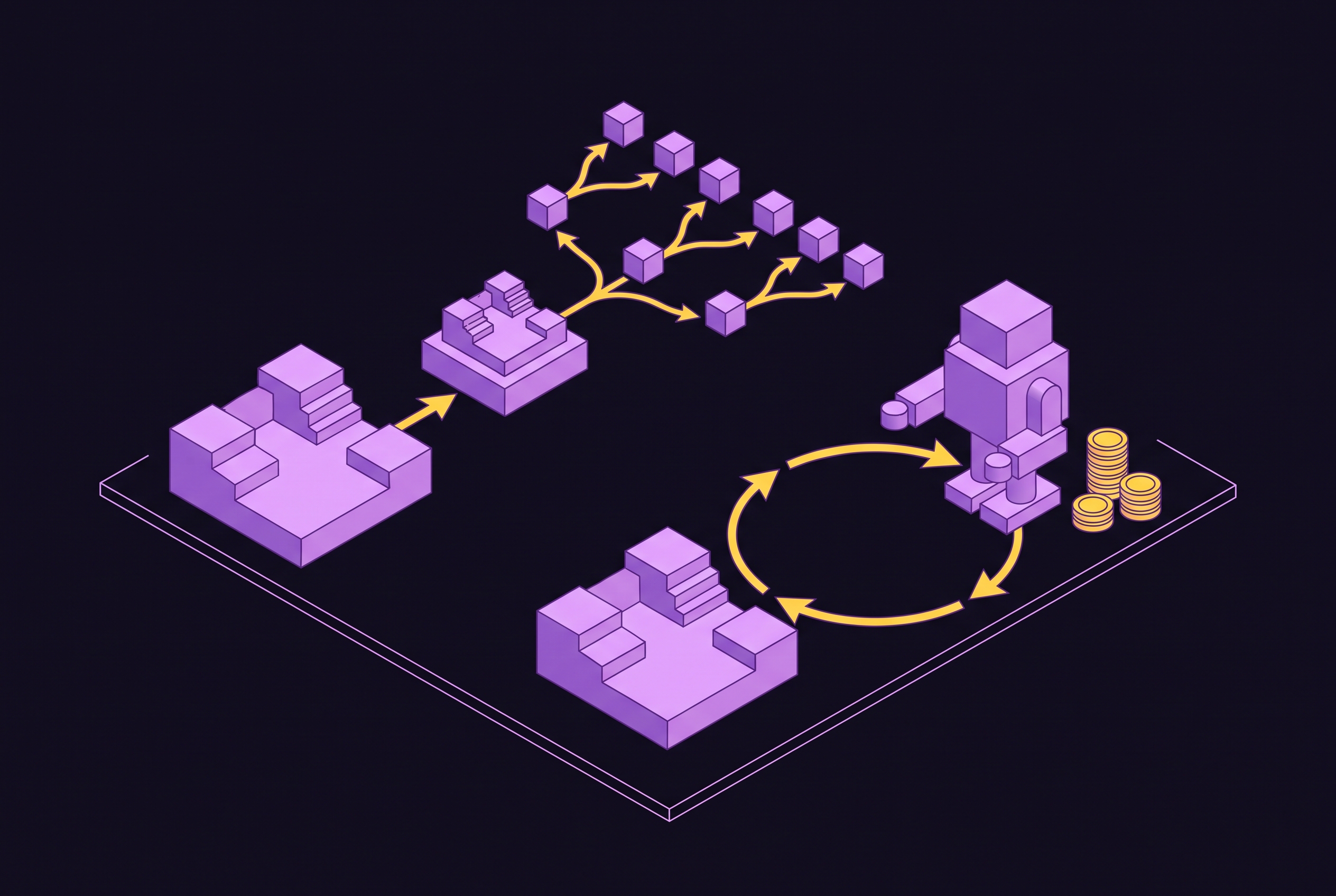
Metamon offers a concrete version of this same logic that doesn't require live matchmaking. The final training set grew to more than 5 million trajectories drawn from real human battles alongside more than 20 million generated through self-play, and that expansion broke through the ceiling that pure offline training had hit. Most practitioners working with a fixed game dataset aren't choosing between two sealed-off paradigms but deciding where on a cost spectrum, from fully offline to a little targeted interaction to self-play augmentation to full online access, their project actually sits.
How offline-to-online fine-tuning behaves across three distinct dataset-quality regimes
Offline-to-online fine-tuning has a reputation for instability, methods that work well on one task collapse on the next, but researchers at Mila and the Université de Montréal (Li et al.) show that the instability follows a predictable pattern. Matching the fine-tuning method to that relationship changes which method performs best, more than swapping in a different base algorithm does.
Three regimes fall out of that comparison. In the first, the pretrained policy already outperforms what the offline dataset alone would suggest, and stability needs to be anchored to the policy's own parameters; methods that drop the offline dataset during fine-tuning, such as WSRL, perform better here, with antmaze-large-play-v2 on D4RL serving as the framework's example case. In the third, the policy and the dataset are roughly comparable in quality, and the task becomes balancing both sources of stability while leaving enough room for the policy to keep improving; no single method wins outright in this regime.
Offline RL regularization supplies strong stability and noticeably less performance loss early in fine-tuning, but that same stability limits how much the policy can still adapt, so it only beats a simple online warm-up in a minority of cases, mainly when the pretrained policy is already close to optimal before fine-tuning starts. The framework held up across 21 dataset-task combinations spanning four D4RL domains, Mujoco locomotion, AntMaze, Adroit, and Kitchen, aligning with its own predictions in 45 of 63 tested cases. For a practitioner working from a fixed game dataset, the first diagnostic is whether the pretrained policy or the dataset is the stronger of the two, answered by an actual rollout in a held-out environment.
Where the offline-only path still makes sense
Staying offline is the correct call under two conditions holding at once: interaction with the environment is genuinely too costly to get, and the dataset covers enough of the state-action space to represent what the deployed policy will encounter. Either condition on its own isn't enough.
Genuinely prohibitive interaction costs appear in specific, recognizable forms: legacy titles whose simulator no longer runs on current infrastructure, competitive games with hard API rate limits, licensed titles where the replay environment can't be instrumented for RL at all, and multiplayer games where assembling opponents for live training isn't practical. Expert-only archives satisfy it only when the game's state space is narrow enough that an expert's play effectively covers it; random or mixed-quality datasets satisfy it more reliably but bring along weaker action labels.
Algorithm selection stays important even once a team commits to staying offline. Where the behavior policy is already close to optimal, KL regularization can outperform pessimism-based methods because it avoids the policy-constraint penalty that pessimism imposes. Matching the algorithm to the dataset's quality matters inside the offline paradigm too, not only when deciding whether to go hybrid.
Multi-agent games remain the hardest case for staying purely offline. Staying offline, then, requires three things to actually work: a coverage audit confirming the dataset represents the relevant state-action space, algorithm selection benchmarked against that specific dataset rather than chosen by reputation, and a clear-eyed acknowledgment that the resulting policy's ceiling is set by the behavior policy embedded in the data, not by the optimizer used to train on it.
A decision map for choosing between offline, online, and hybrid given a fixed game dataset
Every argument in this piece collapses into three sequential questions: what does the data cover, what does one environment query cost, and how does the pretrained policy compare to the dataset.
The first step is a coverage audit. Does the fixed dataset cover the state-action regions the deployed policy will actually visit? If the answer is yes, and interaction with the environment is genuinely prohibitive, the offline-only path is justified, with algorithm choice matched to dataset quality, IQL or KL regularization for data close to expert quality, pessimism-based methods for data that's more mixed. If coverage is lacking, offline-only is high-risk no matter which algorithm gets used, and the decision moves to the second question.
The second factor is interaction cost. If interaction is truly unavailable by any route, the right move is to stay offline while documenting the coverage gap as a known limit on what the deployed policy can be expected to do.
Once a hybrid, offline-to-online approach is in play, the third question is whether the pretrained policy or the offline dataset is the stronger prior. Where the two are comparable, the right approach balances both sources of stability while keeping enough plasticity for the policy to keep improving.
Two caveats carry more weight than anything else in this framework. And on the hybrid path generally, Zhang and Sinclair's 2026 algorithm offers a formal guarantee worth building into any practical approach: offline data that turns out to be uninformative gets safely ignored, so a properly designed hybrid method never performs worse than pure online learning would have on its own.
Sources
- Offline-Online Reinforcement Learning for Linear Mixture MDPs
Provided the theoretical framework for hybrid offline-to-online learning where uninformative offline data is safely ignored, cited for the linear mixture MDP formalization.
- The Three Regimes of Offline-to-Online Reinforcement Learning
Provided the three-regime framework for offline-to-online fine-tuning instability and the dataset of 63 tested cases across D4RL domains.
- Offline vs. Online Learning in Model-based RL
Provided the analysis of out-of-distribution state-action pair failures and the 31-environment study of offline performance degradation mechanisms.
- Hokoff: Real Game Dataset from Honor of Kings and its ...
Provided details on the Hokoff benchmark built from Honor of Kings data, presented at NeurIPS 2023.