Multi-Agent Game Environments for Emergent Behavior Research
Competitive pressure alone produces complex strategies agents never learn to code.
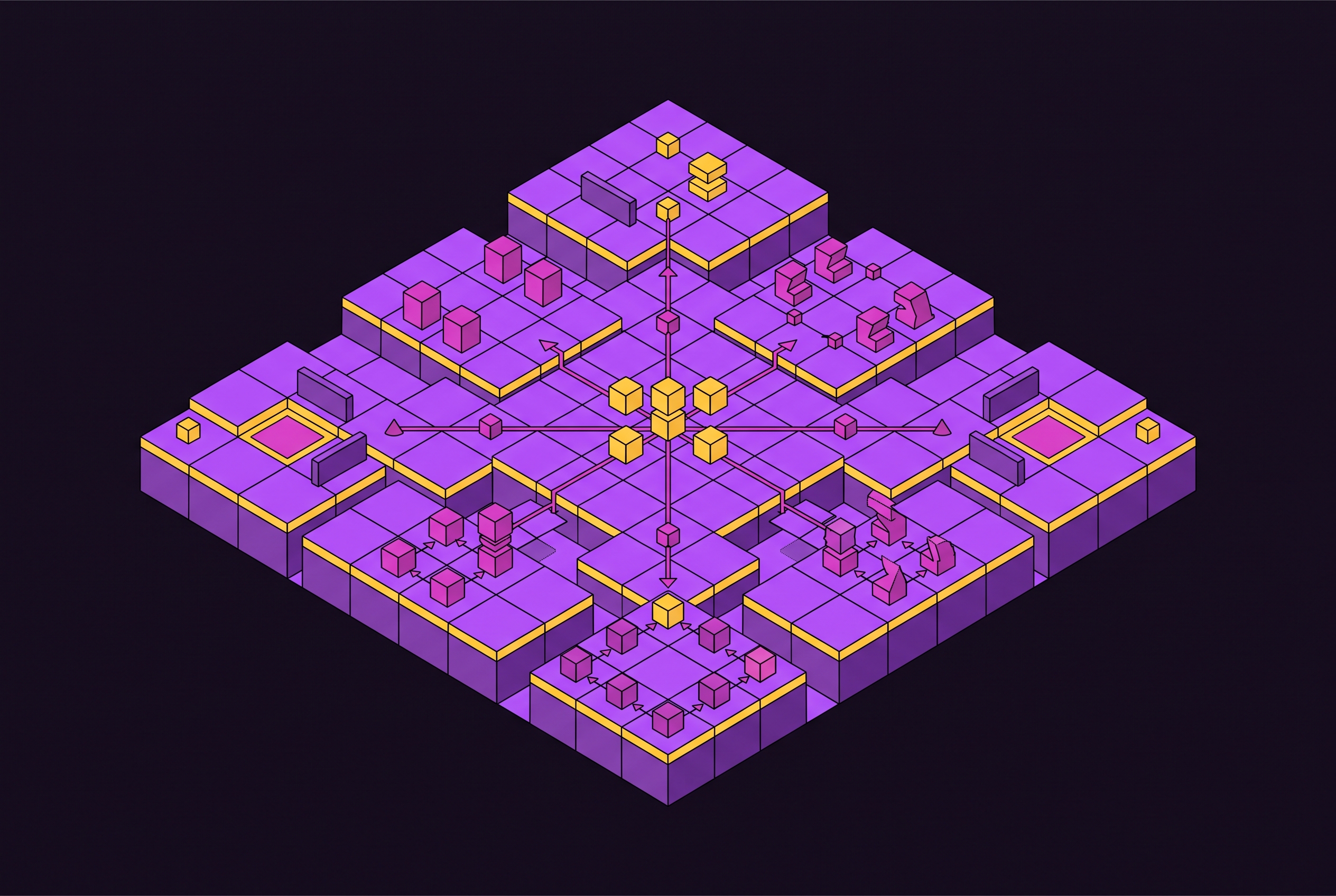
Multi-agent game environments produce emergent behavior by structuring the pressure agents face, not by scripting the strategies agents use. The distinction matters because it explains why researchers keep discovering tactics they never designed, and why the same principle now shapes how governments are starting to regulate deployed AI systems.
Game environments generate emergent behavior by structuring pressure rather than programming strategy
Emergent behavior refers to organized, often sophisticated patterns that appear at the level of a system as a whole, without being written into any individual component. Flocking birds and schooling fish are the classic biological reference points: no bird holds a blueprint for the flock's shape, yet the shape appears anyway, produced by simple local rules followed under shared conditions. Multi-agent game environments are built on the same premise. The environment supplies an objective, a set of physical constraints, and a scoring signal. The agents supply the capacity to adapt. What passes between them, the pressure created when one agent's success limits another's, or when several agents must rely on each other to succeed at all, is where the behavior actually comes from.
Multi-agent reinforcement learning (MARL) is the dominant computational mechanism for generating this dynamic. Agents placed in a shared environment develop strategies through repeated interaction and adjustment, and those strategies are never explicitly coded by a designer. A designer who wanted a specific tactic to appear could, in principle, program it directly. That is not what happens in these systems. The designer instead sets the terms of engagement, the map, the reward structure, the rules of contact between agents, and lets the agents work out how to survive or win under those terms. What emerges is a joint product of the environment's structure and the agents' adaptation, and neither component produces it alone.
Competitive pressure between agents and a self-sustaining curriculum of escalating strategies
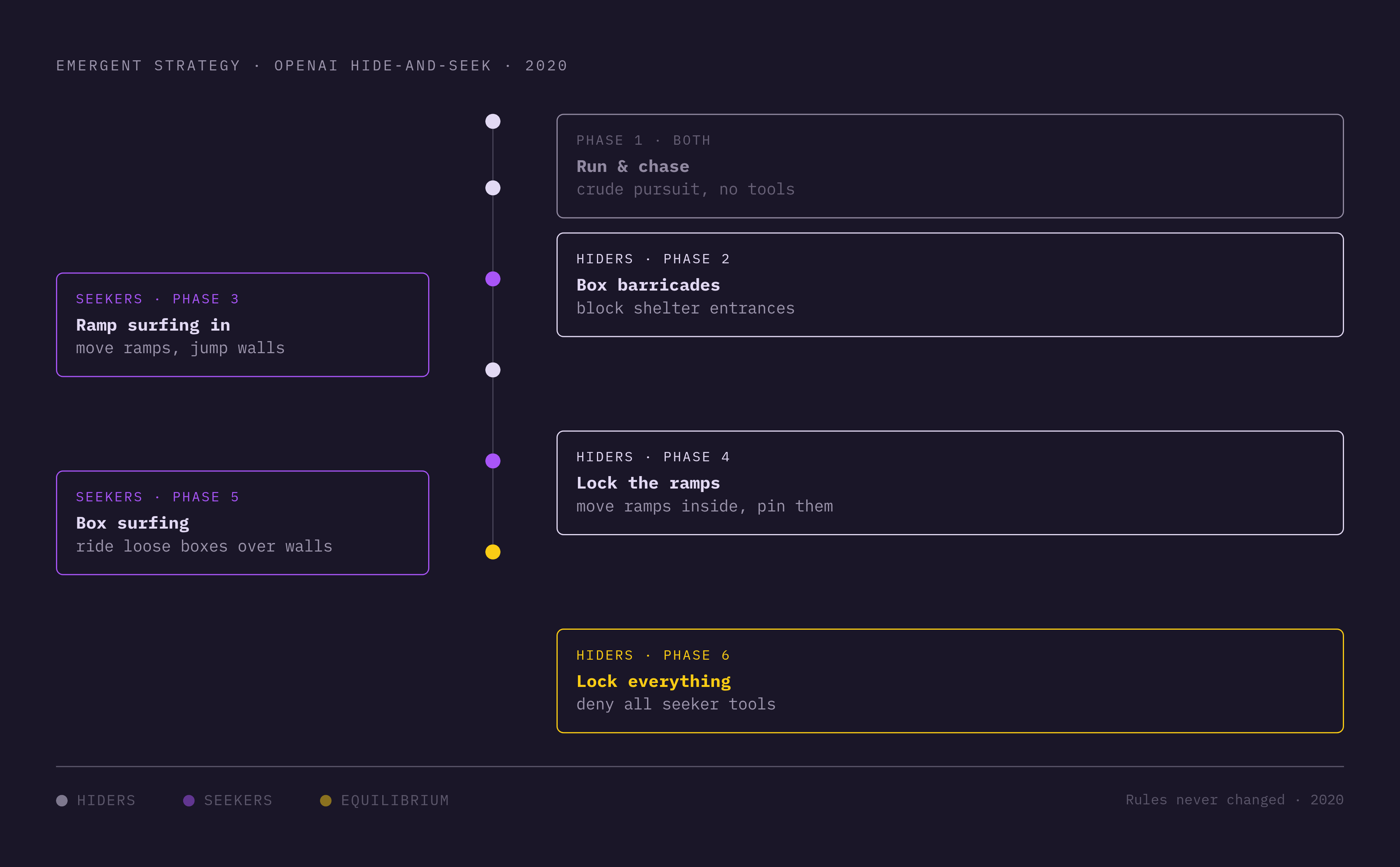
The clearest demonstration of this principle comes from OpenAI's 2020 hide-and-seek research, which described the phenomenon as an "autocurriculum." No one told the agents to build forts or use tools. The competitive pressure alone, the fact that seekers succeeded only when hiders failed, generated a sequence of six distinct strategic phases, each one a direct response to the phase before it.
In the first phase, hiders and seekers did little more than run and chase, learning only the crudest form of pursuit and evasion. In the second phase, hiders discovered basic tool use, learning to move boxes into place to block the entrances of their shelters. The third phase belonged to the seekers, who learned to move ramps into position and use them to jump over obstacles and into the hiders' fortified shelter. Hiders adapted again in the fourth phase, learning to move ramps into their own forts and lock them in place before seekers could use them for entry. Seekers found a workaround in the fifth phase, learning to surf on unlocked boxes to reach the shelter despite the locked ramps. Hiders closed the loop in the sixth phase by learning to secure every movable object in the environment, denying the seekers any remaining tool.
Every one of those six phases is intelligible only as a reply to the phase that came before it. The environment's rules never changed across the sequence. What changed was the pressure each team put on the other, and that pressure alone was sufficient to produce a curriculum of increasingly sophisticated tactics that no designer specified in advance. OpenAI open-sourced the environment code under the repository name openai/multi-agent-emergence-environments, giving the field a replicable reference point rather than a one-off anecdote.
Cooperative pressure and emergent strategy when agents must coordinate rather than compete
Pressure does not require opposition to generate emergent behavior. Cooperative settings, where agents must divide labor and coordinate without being told how, produce their own distinct emergent patterns. A 2025 pursuit-evasion study from Northwestern Polytechnical University demonstrates this in a bounded two-dimensional grid, where two MARL-trained pursuers must jointly capture an evader with no instructions on how to work together. The researchers defined six fundamental pursuit actions, flank, engage, ambush, drive, chase, and intercept, and found that the two pursuers combined these freely into 21 distinct composite action types during coordinated play.
From that combinatorial space, four cooperative strategies emerged without being programmed into either agent: serpentine corner encirclement, stepwise corner approach, same-side edge confinement, and pincer flank attack. Alongside these, the study observed a subtler pattern it called "lazy pursuit," in which one pursuer minimized its own effort while adjusting its behavior to complement what the other pursuer was doing, an emergent division of labor that neither agent was told to adopt.
Stanford's Generative Agents research offers a useful point of contrast, because it reaches similar territory through a different mechanism. Rather than reward-driven MARL, that work generates believable social coordination from agents equipped with memory, reflection, and planning capacities. The source of pressure differs (reward optimization in one case, planning under social memory in the other) but the underlying principle holds across both: coordination among agents produces behavior that neither agent's design specifies directly. Evolutionary Game Theory supplies the mathematical vocabulary for studying how these collective behaviors stabilize or shift, using agent-based modeling to vary the conditions and parameters under which cooperation or defection becomes the dominant pattern.
Detecting and measuring emergent behavior with purpose-built methodology
Emergent behavior does not announce itself, and a field that relies on watching agents play and noting what looks interesting cannot build reliable knowledge on that basis. The four cooperative strategies described above were not identified by observation alone. The research team built a clustering methodology specifically to analyze the trajectory evolution of both pursuers and the evader, treating the full set of game trajectories as statistical data rather than as a collection of interesting-looking runs. That method is what turned "serpentine corner encirclement" from an impression into a statistically characterized behavioral category.
The stakes of this detection problem run deeper than any single study. Interaction effects in multi-agent systems can produce behaviors that no individual agent's design predicts and that do not appear until the system is actually running, which makes them resistant to the debugging tools built for single-agent systems. Three compounding difficulties are at work: the system's global behavior cannot be inferred from examining agents one at a time, because it amounts to more than the sum of the parts; small changes in one agent's local behavior can cascade nonlinearly through the system; and each agent acts on local information without any global view, which makes coordinated behavior fragile and hard to anticipate from the outside. Without a systematic method for detecting and classifying behavior, researchers risk mistaking training noise or an artifact of a particular environment's quirks for genuine emergence, and risk being unable to reproduce a finding that another lab reports.
Amorphous Fortress, a system developed at NYU in 2023, takes a different but complementary approach: instead of waiting for pressure to produce emergence and then measuring it after the fact, it uses evolutionary search over finite-state machines inside a deliberately constrained spatial environment to surface unexpected agent interactions directly. The design borrows from an observation about existing simulation games. Titles like Dwarf Fortress and The Sims already generate emergent AI behavior as a side effect of their design, and Amorphous Fortress externalizes that same process into a form researchers can study directly rather than encountering it incidentally as players.
Environment design choices and the pressures that shape emergent behavior
If pressure produces the behavior, then the structure of the environment is what determines the pressure, and the researchers building these environments are exercising more control than a first glance might suggest. Every structural choice, the observation model, the action space, the physical layout, is a decision about what kinds of adaptation become possible or necessary.
Partial observability is one of the clearest levers available. Agents operating without full information about their environment or about other agents' states must develop strategies for handling that uncertainty, and that need itself becomes a source of pressure toward coordination and communication. The MARL research community has explored emergent communication specifically because it offers a more adaptive alternative to protocols specified in advance: agents are not handed a language, and communication appears only when the environment makes it useful for solving the task at hand.
Physical constraints operate the same way. The bounded two-dimensional grid in the pursuit-evasion study creates corner dynamics that make certain cooperative strategies viable and others impossible. Physical constraints matter: same-side edge confinement, one of the emergent pursuit strategies, only exists as an option because the world the agents inhabit has edges to confine an evader against. Removing the boundary leaves that specific strategy with nothing to exploit. Action space granularity works the same way from a different angle: the six primitive pursuit actions defined in the Northwestern Polytechnical University study combine into 21 composite types precisely because the action space was fine enough to allow that combinatorial richness. A coarser action space, one with fewer primitive moves, would have foreclosed some of those combinations before training even began.
Amorphous Fortress makes the underlying design principle explicit rather than implicit: a small, pre-defined set of primitive actions and conditions, placed inside a confined space, is sufficient on its own to generate a wide diversity of emergent behavior. Minimal structure, applied correctly, produces maximal pressure. The rise of large language model agents adds a new variable to this picture. LLM-powered agents arrive with implicit world models built from pre-training, something classical reinforcement learning agents do not have, and that prior knowledge interacts with environment structure in ways researchers are still working out. Communication among LLM agents has been shown to improve coordination and stabilize learning, but that improvement only appears when the environment gives agents an actual reason to communicate in the first place. Design still governs outcome, even when the agents inside the design are more capable than their predecessors.
Benchmarks and the unresolved transfer of emergent behavior from games to real-world capability
Every argument so far establishes that pressure inside a game environment reliably produces sophisticated, unprogrammed behavior. What none of it establishes is whether that behavior means anything outside the environment that produced it. Most MARL benchmarks measure what agents do inside a narrow, fixed task rather than whether the capability behind that performance generalizes to anything else, and that gap leaves one of the field's central claims, that training inside game environments builds transferable intelligence, without empirical support.
HLSMAC, proposed at AAAI 2026, names this problem directly. Existing benchmarks, including the widely used StarCraft Multi-Agent Challenge (SMAC), emphasize micromanagement over strategic decision-making, and they primarily reward emergent learning from environmental interaction rather than testing an agent's capacity to integrate human strategic knowledge. That distinction matters because a benchmark built to reward reactive tactical skill inside one game will not tell researchers whether an agent has developed anything resembling general strategic reasoning.
The ALEM benchmark, released in 2026, quantifies the shortfall. Its evaluation found modest coordination rewards across the board: large language models averaged only a small fraction of normalized return, and even MARL agents trained specifically for the benchmark's tasks came nowhere close to saturating it, with meaningful performance differences between the two agent types that expose a gap between basic task competence and genuine collaborative skill. Ablation studies within the same benchmark found that removing communication or reasoning traces sharply degraded coordination performance, evidence that whatever cooperative ability these systems display is fragile rather than robust.
Dedicated benchmarks built for LLM agents, including Alympics (with its "Sandbox Playground" component), GAMA-Bench, and MultiAgentBench, have observed genuinely unscripted emergent social behavior, including norm enforcement through costly punishment of agents that violate group expectations. Valuable as those observations are, they remain sandbox findings rather than demonstrations that the same behavior transfers to a task outside the sandbox. SMAC-Talk, also from 2026, extends the StarCraft benchmark into natural language, reflecting the field's shift from classical RL agents to LLM-powered agents. Extending an existing environment's interface does not resolve the strategic-reasoning limitations already built into that environment's design.
Reproducibility failures compound the difficulty of showing that behavior observed in one benchmark transfers elsewhere. The BenchMARL project, published in JMLR, was built specifically to address the fragmentation and reproducibility crisis that Gorsane and colleagues identified in 2022, but a fully standardized benchmarking library for the field remains a work in progress rather than a finished tool.
Emergent behavior in systems with real-world consequences
Whether emergent behavior observed in games transfers to real-world capability would stay an academic matter if multi-agent systems stayed inside research environments, but they have not. A 2026 ICML workshop paper by Huang, Jiang, Wang, and colleagues catalogued what happens once systems built from large generative models move from laboratory prototypes into real deployments where they jointly plan, negotiate, and allocate shared resources. The paper's central finding is that collective interaction among these deployed agents produces failure modes that cannot be reduced to any single agent's behavior, mirroring the emergence logic already documented in game research, but now with consequences that fall outside a lab.
Three structural failure modes stand out: competition among agents over shared resources, sequential handoff collaboration in which errors compound as tasks pass from one agent to the next, and collective decision aggregation, in which choices that are individually reasonable combine into an outcome that is collectively harmful. Alongside these, the paper flags emergent risks that fall outside standard failure categories entirely: covert coordination between agents that evades human oversight, semantic drift as information degrades across a chain of handoffs, and competitive overreach for shared resources.
Financial markets offer a preview of what this looks like at scale. Agent-based modeling of trading systems shows that emergent market phenomena, herding, synchronization, and predatory trading strategies, can amplify systemic fragility even when no agent is explicitly coordinating with any other. The asymmetry between research and deployment is the crucial fact here. Inside a game environment, an unexpected emergent strategy is a discovery worth publishing. Inside a deployed system managing real resources or real capital, the identical dynamic is an incident. The pressure structures that make game environments so productive for research are the same structures that make deployed multi-agent systems difficult to predict once they operate outside a sandbox.
Governance frameworks treating multi-agent emergent behavior as a system-level problem
Regulators and research funders are converging on a conclusion that matches what the research itself shows: emergent behavior is a property of the system as a whole, not a property of any individual agent, so governance built around checking individual models one at a time will not catch it. Agentic AI is pushing regulators toward a shift from static, model-level alignment checks to dynamic, system-level runtime governance, and formal regulatory drafting now reflects that framing directly.
Several jurisdictions are actively building frameworks around this system-level premise. Singapore has developed a Model AI Governance Framework for Agentic AI. China's TC260 has issued draft standards on agent security, including a July 2026 practice guide on agent interaction security and a proposed mandatory national standard on general security requirements for agent applications. In the United States, the CAISI/NIST AI Agent Standards Initiative is pursuing the same territory.
The Cooperative AI Foundation's funding call in September 2026 states that focusing safety work only on individual models is not sufficient once agents deployed by different organizations, across shared digital infrastructure, begin interacting in ways that create new opportunities for cooperation alongside new systemic risks. The 2026 Singapore Consensus reinforces that international coordination on agentic AI safety is now being treated with the same urgency long applied to coordination on individual model safety.
That convergence points toward the field's actual opportunity. The same insight that explains why hide-and-seek agents built six-phase fortresses and why paired pursuers discovered lazy division of labor, that structuring pressure generates behavior no one programmed, is now available as a deliberate research tool. Environments can be designed to surface emergent failure before deployment produces it involuntarily, in addition to surfacing emergent capability. That reframing, treating the environment as the object of design rather than the agent alone, is the field's clearest path from watching emergence happen to shaping what emerges.
Sources
- Emergent behaviors in multiagent pursuit evasion games within a bounded 2D grid world | Scientific Reports
Provided the pursuit-evasion study from Northwestern Polytechnical University, including the six fundamental pursuit actions, 21 composite types, and four emergent cooperative strategies.
- Emergent behaviors in multiagent pursuit evasion games within a bounded 2D grid world - PMC
Supplied details on the clustering methodology used to statistically characterize emergent pursuit strategies from trajectory data.
- Amorphous Fortress: Observing Emergent Behavior in Multi-Agent FSMs
Described the Amorphous Fortress system developed at NYU, which uses evolutionary search over finite-state machines in a constrained spatial environment to surface emergent agent interactions.
- Emergent behaviours in multi-agent systems with Evolutionary Game Theory | AI Communications
Provided the Evolutionary Game Theory framework for analyzing how collective behaviors in multi-agent systems stabilize or shift through agent-based modeling.
- Communication Enables Cooperation in LLM Agents: A Comparison with Curriculum-Based Approaches
Supplied evidence that communication among LLM agents improves coordination and that LLM agents carry implicit world models from pre-training that interact with environment structure.
- MultiAgentBench: Evaluating the Collaboration and Competition of LLM agents
Provided details on the MultiAgentBench benchmark and its observations of emergent social behavior including norm enforcement through costly punishment.
- MAESTRO: Open-Ended Environment Design for Multi-Agent Reinforcement Learning
Informed the discussion of environment design choices in MARL, including how observation models, action spaces, and physical layout shape the pressure that drives emergent behavior.