Exploration Strategies for Procedurally Generated Game Environments
Different algorithms encode different spatial grammars that guide what explorers should search for.
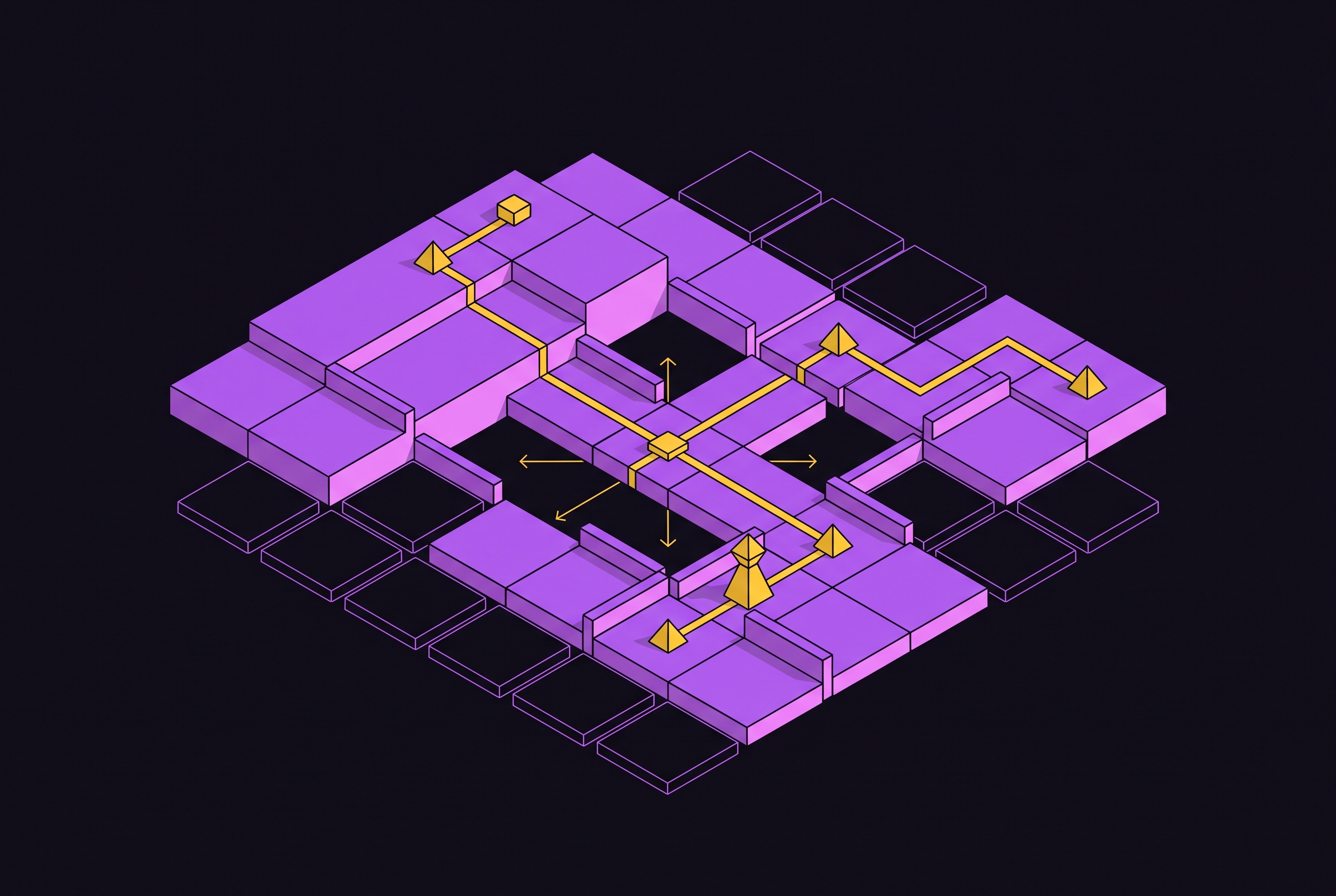
Procedural generation is often treated as a single technique, a way to make levels without paying a level designer to place every wall. That framing obscures what actually matters. The algorithm a game uses does not just determine what the world looks like. It determines what kind of searching is possible inside it. Exploration strategy is downstream of the generator.
Why the generation algorithm determines what exploration can mean in a procedural world
The disorientation a player feels entering a new procedural world is not an artifact of randomness. It is a property of the algorithm that made the world. A noise-based terrain produces continuous gradients. A BSP dungeon produces discrete rooms connected by corridors. A Wave Function Collapse map produces tile patterns that obey learned local rules. Each of these is a different spatial grammar, and each grammar makes a different set of moves productive. The practical payoff is identical in both directions: knowing the algorithm is knowing which way to move.
What each core algorithm builds and why the structure differs
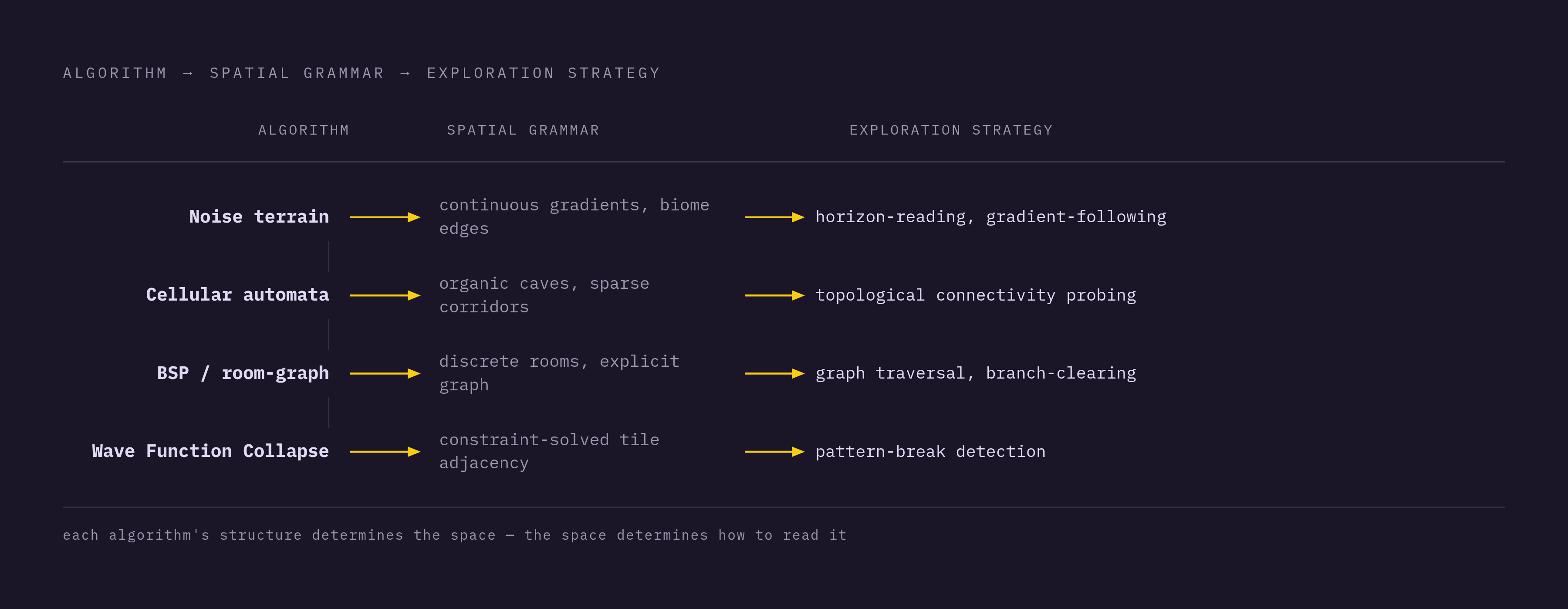
The terrain a player navigates is the output of an algorithm, and each major PCG algorithm produces a fundamentally different spatial grammar. Noise-based terrain, built from Perlin or Simplex functions, generates continuous landscapes with smooth transitions and emergent biome boundaries. There are no discrete rooms here. The explorer's problem is horizon-finding and biome-reading, not path-tracing. Cellular automata work differently. They apply neighbor-count rules to a random seed grid over multiple passes, producing organic cave shapes: irregular, blob-like voids with few corridors. The explorer's problem here is topological, a matter of asking whether this cave connects to the next one, rather than directional. BSP and room-graph dungeons operate on yet another logic. They recursively split space into regions, place a room in each, and connect those rooms with hallways. The output is a set of discrete, enumerable rooms with an explicit connective graph. The explorer's problem becomes graph traversal: which doors have been opened, which branches remain. Wave Function Collapse introduces a fourth grammar. It is a constraint solver that collapses cells by lowest entropy and propagates adjacency rules learned from a sample. The result is a tile-based environment that feels handcrafted because every local relationship is locally plausible. The explorer's problem is reading pattern breaks, because where coherence fails is where secrets live. Each of these algorithms produces a different kind of search problem, and no one of them is inherently better. The question is fit.
How noise-based open worlds redirect exploration from path-following to horizon-reading
In a noise-generated open world, productive exploration is not about finding a path to a destination. It is about reading environmental gradients to infer where meaningful content is likely to cluster. Exploration becomes ecological rather than cartographic. You read elevation changes and biome transitions as signs of where differentiation is highest, then move toward those places. This works because the generator's structure is made visible in the gradient itself. The world is large, but every horizon offers the same thing. With them, the horizon-reading skill regains its object: the player reads the gradient to find the places where designed content interrupts it.
How BSP and room-graph dungeons reward graph-awareness over environmental reading
A BSP dungeon is an explicit room-and-corridor graph, and the exploration strategies that work inside it are graph-traversal strategies. The reason is structural. BSP recursively divides space and connects regions, so the output is a tree or graph of rooms with guaranteed connectivity. Every room is reachable, and the structure is enumerable even when the player cannot see all of it. Spelunky is the anchor case. The graph is always solvable, so aggressive exploration, trying every branch, is always viable. There is never a risk of exploring into an unwinnable state. For the designer, the implication is direct: in a BSP dungeon, the depth of the exploration experience is controlled by the richness of room templates and the density of the connection graph. The algorithm guarantees structure, but variety within nodes determines whether repeated exploration remains interesting. The graph is what makes aggressive coverage rational in the first place.
How Wave Function Collapse shifts the exploration signal from structure to local coherence breaks
Wave Function Collapse rewards a different exploration instinct. Anomalies and pattern violations become the primary exploration signal. Picture a perfectly tiled forest where every tree spacing honors a learned adjacency rule, and then one broken wall interrupts the pattern. That break is the signal. WFC works as a constraint solver: it collapses the lowest-entropy cell, propagates adjacency rules learned from a sample, and generates content that satisfies those rules. The result feels handcrafted because local tile relationships are always locally plausible. The exploration heuristic follows from the structure. The exploration signal can be embedded directly in the generation rules.
Why the fixed underlying structure of a procedural world is what makes exploration meaningful across runs
Across all PCG algorithms, what makes exploration meaningful is not the specific layout of any given instance. It is the invariant rules and dependencies that every instance shares. Effective exploration is the process of discovering those invariants. For designers, the same principle holds in reverse: enriching the invariant structure, adding more achievement dependencies, more biome interaction rules, more room-type relationships, directly enriches the exploration potential across all generated instances, not just one.
How Fog of War and curiosity mechanics operationalize the invariant structure as a player-facing exploration loop
The invariant structure is abstract. Fog of War and curiosity-triggering design patterns are the mechanics that translate it into a felt exploration drive. Without them, even a richly structured procedural world fails to pull players forward. Four design patterns have been identified as triggers for spatial exploration, and each surfaces the invariant structure without stating it explicitly: reaching extreme points, resolving visual obstructions, out-of-place objects, and understanding spatial connections. Out-of-place objects are particularly relevant to WFC environments, where the generator's coherence rules make anomalies visually salient. Mismatching them dissipates it. Extreme-point rewards in a flat BSP dungeon would do nothing, because the structure contains no gradients to reward.
Why pure procedural breadth without emergent depth produces neutral rather than engaged exploration
Procedural breadth, more rooms, more planets, more terrain, does not by itself produce meaningful exploration. What produces meaning is the depth of emergent effects that the invariant structure enables players to discover through movement. Players in procedurally generated environments tend to experience neutral rather than strongly positive emotions when the generation produces visual variety without behavioral or systemic variety. Repetitive designs and limitations reduce satisfaction. The mechanism is structural. When all generated instances feel equivalent, when creature behaviors are the same, room functions are the same, resource distributions are the same despite visual differences, the invariant structure is too shallow to reward continued discovery. Players learn the rules too quickly, and exploration collapses into traversal. No Man's Sky at launch is the direct case: the universe was vast, but the variety was skin-deep, and the exploration loop did not hold. Achievement structures carry a related risk. If the dependency graph is too shallow, with few dependencies and obvious progression, the invariant structure is discovered quickly and exploration becomes a checklist. Serendipity, the quality that makes procedural exploration distinct from linear progression, disappears. The failure is not a content-volume problem. Adding more generated content does not fix shallow emergence, because the shallowness is in the rules the content instantiates, not in the quantity of instances.
How hybrid design — handcrafted rules inside procedural systems — builds the depth that pure generation cannot
The most effective procedural exploration experiences use handcrafted content not as a substitute for generation but as the building material fed into the generator. This enriches the invariant structure without abandoning scale or replayability. Spelunky is the clearest case. Designers built hand-tuned room templates and connection graphs that the generator assembles, so every generated level is both unique and guaranteed beatable. The handcraft is in the rules, not the output. Hades, from Supergiant Games, extends the pattern. The game combines procedurally generated dungeons with authored narrative and character development, so the invariant structure includes not just spatial rules but story dependencies. Exploration surfaces both new rooms and new dialogue, and the narrative survives and benefits from randomized exploration. The general pattern is precise: effective hybrids create room templates, encounter types, or narrative fragments that algorithms assemble. The handcraft defines the vocabulary. The algorithm defines the sentence. The designer's practical task is to identify what the algorithm cannot produce, emotional weight, guaranteed solvability, narrative causality, and supply it as structured handcrafted input. The corollary is to identify what handcraft cannot produce at acceptable cost, scale, replayability, surprise, and let the algorithm handle it. There is an objection, which is that hybrid design reintroduces the cost and time that procedural generation was meant to eliminate. The answer is that the cost is not in producing content but in producing rules. One well-designed room template generates thousands of valid rooms. The investment scales differently than manual placement.
What episode-level exploration scoring reveals about why state-counting strategies fail in PCG environments
Reinforcement learning research has hit the same wall that players hit, and it reveals the structural reason in precise terms. Standard intrinsic reward methods, count-based and curiosity-driven, work by rewarding novel states. They assume the agent will revisit states and that novelty diminishes over time. In a procedurally generated environment, every episode produces a new environment, so the same state is unlikely to appear twice and novelty never diminishes meaningfully. The state-counting strategy is simply the wrong unit of measurement. RAPID, published at ICLR 2021, addresses this by scoring exploration at the episode level rather than the state level. Each episode is treated as a whole, scored by how thoroughly it covered the generated environment, and high-scoring episodes are stored and imitated. This is an episodic, not incremental, exploration strategy. A player who tries to clear every room in a BSP dungeon is doing something structurally similar. The right unit of measurement is the run, not the tile. SEA, from ICLR 2023, takes a complementary approach. Instead of scoring coverage, it recovers the achievement dependency graph from collected trajectories and uses that structure to direct future exploration. The invariant structure is the object of discovery, not a byproduct of wandering. The combined lesson is that exploration in procedural environments is most efficient when it targets the invariant structure of the generator, not the specific layout of any single generated instance. This is the same principle that explains why Spelunky veterans read room templates rather than reacting to room contents. The skill is transferable because the rules are shared.
Practical exploration heuristics matched to each algorithm type
Each algorithm produces a different invariant structure, so the exploration heuristics that work are algorithm-specific. Knowing which algorithm you are inside is a learnable, practical skill. In noise-terrain worlds like Minecraft and No Man's Sky, read the gradient before moving. Elevation changes, biome transitions, and resource density bands are the generator's structure made visible. Move toward gradient extremes: peaks, biome edges, ocean floors, where differentiation is highest. In shallow-emergence noise worlds, recognize quickly when the gradient is not paying off and treat that as a signal that the invariant structure is thin. Adjust expectations or seek hand-placed anchors like dungeons and structures. In BSP and room-graph dungeons like Spelunky and The Binding of Isaac, treat the dungeon as a graph problem. Systematically clear branches, mark dead ends, and count unexplored connections. The graph is always solvable and always finite, so aggressive coverage is always rational. Learn the room template vocabulary across runs. If you recognize template types, you can predict connection counts and reward likelihood before entering a room. In cellular automata caves, the exploration problem is topological. Connectivity is not guaranteed by design, so probe for passages before committing to a direction. Backtracking cost is high in cave systems, so map exits before going deep. In WFC environments like Caves of Qud, move toward entropy. Seek tile combinations that appear rarely in the surrounding pattern, and treat coherence breaks as high-probability reward zones. Learn the normal tile grammar of a zone quickly, one or two traversals of representative areas, so that deviations register as signals. Across all algorithm types, the most durable exploration skill is identifying the invariant structure of the generator, the rules that every instance shares, and targeting discovery of that structure rather than exhaustive coverage of any single instance. For designers, the corollary is to surface the algorithm's structure through mechanic scaffolding: Fog of War for spatial incompleteness, anomaly objects for WFC coherence breaks, visible connection points for BSP graphs, biome-edge rewards for noise terrain. This lets players apply the right heuristic without needing to know the algorithm explicitly. The goal in both directions is the same: read the generator, and the world reads back.
Sources
- Learning Achievement Structure for Structured Exploration in Domains with Sparse Reward
Provided the basis for the SEA approach described in the article, which recovers achievement dependency graphs from trajectories to direct exploration in procedurally generated environments.
- Rank the Episodes: A Simple Approach for Exploration in Procedurally-Generated Environments
Provided the basis for the RAPID method described in the article, which scores exploration at the episode level rather than the state level in procedurally generated environments.