Strategy Transfer From Real-Time Strategy Games to Multi-Step Decision Problems
Hierarchical planning skills from RTS games transfer when tasks share the same decision structure.
Real-time strategy (RTS) games are useful proxies for multi-step decision problems because they demand hierarchical planning, decisions under partial observability, opponent modeling, and resource allocation under time pressure. Those similarities give grounds to expect some transfer, but they do not promise general cognitive improvement. Skills are most likely to generalize when the problem outside the game shares the game’s decision structure and training explicitly connects the two.
What makes RTS games structurally unusual as decision environments
Partial observability, commonly called “fog of war,” hides opponents’ positions, intentions, and resources, forcing decisions without complete information. Meanwhile, strategic resource planning, logistical production queues, and local combat each move at a different pace. None waits for the others to finish. A decision-maker must therefore manage several processes whose demands compete for attention but remain causally linked.
That concurrency makes the action space more than a large menu of independent choices. Build-order optimization research treats production planning as a resource allocation problem in which the objective is to minimize time to production goals under concurrent execution and dependencies. An investment changes what becomes possible later, while its consequences may take minutes to emerge. Choosing between economic growth and military capacity therefore involves both sequencing and delayed feedback. The value of a move cannot always be judged when it is made.
A fixed plan degrades as the opponent responds, so effective play requires continuous revision rather than faithful execution of an initially sound sequence. These features set RTS problems apart from tasks that can be solved with a single calculation.
How hierarchical decomposition is the load-bearing mechanism of RTS cognition
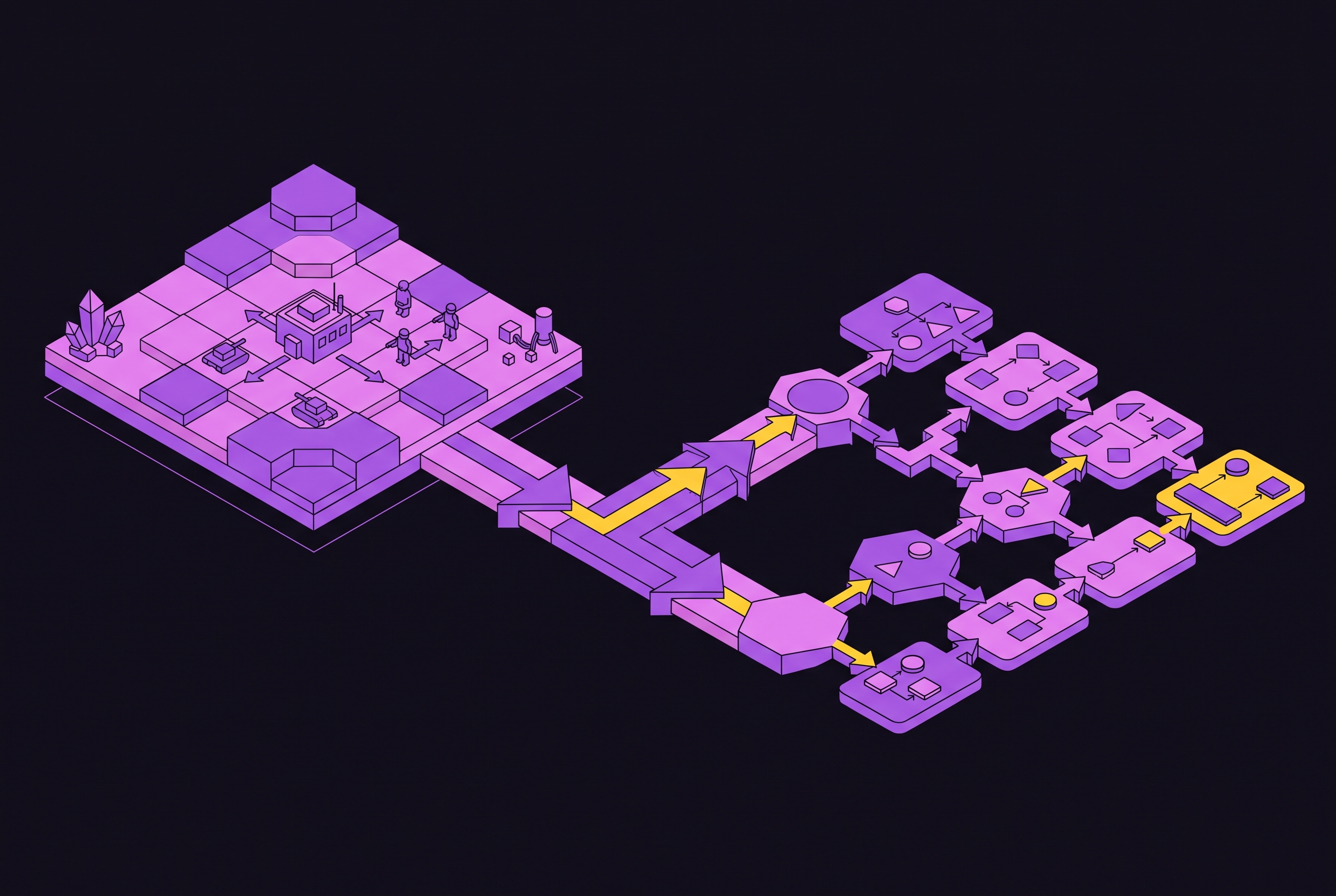
Hierarchical decomposition makes those demands tractable by dividing a long-horizon problem into nested sub-goals with different tempos and information needs. At the strategic level, global resource allocation, technology paths, and attack timing depend on sparse global information. Logistics translates that intent into production queues, supply management, and expansion. Tactical control covers quick decisions about where to position units and how to fight in a local area.
STRATA formalizes this division through a Strategic Agent, Logistics Agent, and Tactical Agent with distinct information scopes, decision authority, and update frequencies. The separation addresses a basic coordination problem. A single decision-maker handling all three levels can miss fast tactical events or lose the strategic thread. Hierarchy insulates the levels from each other’s noise while preserving their relationship. An urgent tactical need does not have to drive every strategic choice.
StarWM-Agent applies related logic through a world model and a Generate–Simulate–Refine loop. It supports preemptive macro-management, including anticipation of supply bottlenecks, and lightweight combat feasibility assessment. These predictive activities address different timescales within the same planning framework. The potential connection to supply chain management, military campaign planning, and corporate strategy lies in that organization of decisions. RTS skills can transfer because hierarchical decomposition is a domain-general problem-solving structure.
What cognitive science finds when humans train on RTS games
Research on humans shows measurable gains from RTS training, but those gains are mostly in particular executive functions. Planning, working memory, and cognitive flexibility fit closely with the need to keep goals in mind while switching between levels of control. The evidence does not establish comparable broad gains in raw processing speed or attention breadth. The distinction is important for interpreting improved performance. Better coordination of decisions is not equivalent to a general increase in cognitive ability.
The StarCraft cognitive flexibility study found that forty hours of training produced significant gains over an active control group playing The Sims. That comparison supports an effect specific to RTS training. The StarCraft 2 expertise study examined players across seven skill leagues, from Bronze through Professional, and identified cognitive-motor, attentional, and perceptual markers that distinguished skill levels. Those markers show that expertise has a measurable cognitive signature. They do not, by themselves, establish that training caused every difference between more and less skilled players.
RTS play requires sustained maintenance of information and rapid switching across multiple sources under high cognitive workload for extended periods. That makes it a strong candidate for tuning the cortical networks involved in executive control. Yet a plausible mechanism and gains on cognitive measures do not establish whether these gains leave the game.
Why those gains rarely travel far from the training task
Evidence for far transfer is weak and contested. Near transfer means improved performance on tasks closely resembling the training task, while far transfer concerns tasks with little surface similarity. Most claims that game training improves real-world decision-making require the latter. Simons et al. concluded that broad brain-training claims of domain-general improvement have not materialized in controlled evidence. That finding directly challenges any unqualified claim that becoming better at RTS play makes someone a better strategist elsewhere.
The objection cannot be answered by pointing to complexity alone. People can learn a great deal from one demanding activity without getting better at another. Nor does a shared label such as “strategy” establish a shared cognitive process. If improvement reliably stays close to training, the warrant for extending RTS findings to business or military decisions must be more specific than their apparent resemblance.
Structural similarity provides that narrower basis for the claim. Transfer is better understood as a gradient tied to how closely training and target tasks share hierarchical decomposition, partial observability, and opponent modeling. Tasks that look different can share a decision structure, though that shared structure alone does not prove that transfer works. It identifies where a transfer hypothesis is warranted. The productive question is therefore which real-world problems share enough of the RTS decision architecture to justify expecting, and evaluating, improvement.
How scaffolding conditions determine whether structural overlap produces actual transfer
Structural overlap becomes useful only when learners can recognize and apply it. An analysis of individual interviews with 41 participants attributed successful transfer to mentorship, collaborative problem-solving environments, autonomy, and guided checklists. Failure to detect transfer was explained by unfamiliarity with game rules, limited practice time, and established cognitive habits. These are accounts of learning conditions. The environment supplies opportunities that learners may not extract unaided.
Scaffolding changes the role of game-based learning from passive exposure to structured practice. A mentor or institutional framework can shift attention from winning as an end in itself to hierarchical planning and resource allocation under uncertainty. That distinction separates game performance from an articulated decision principle. Players who do not understand the rules or lack guided reflection may fail to identify the structure embedded in the mechanics. A rich task is not automatically an effective curriculum.
STRATA’s experience card mechanism offers a formal analogue for AI. After each match, a Review Agent derives candidate experience from game traces, validates it across subsequent matches, and compresses it into retrievable cards. For practitioners, the corresponding design implication is to use scaffolding to make the relationship between game-derived principles and the target domain available for use.
Where AI systems hit the same walls that limit human transfer
Conventional deep reinforcement learning methods in RTS environments face limitations in scalability, generalization, and interpretability. Success in one game or scenario does not reliably extend to another. Strong single-agent results also do not translate straightforwardly to multi-agent settings. Complex interaction dynamics, constrained communication, varying notions of optimality, and adversaries each complicate the task.
These difficulties expose the limits of learning successful behavior within a particular environment. LLMs can be impressive at action-sequence prediction yet struggle with dynamic, long-horizon tasks that call for ongoing changes to plans as resources and battlefield states change. Predicting a sequence is not enough. A plan must remain workable after other agents act and previously hidden information becomes available. The parallel with human transfer lies in this dependence on context.
CARL, the Case-Based Reinforcement Learner, showed significant performance gains in MadRTS only when explicitly allowed to transfer knowledge from previous tasks. MadRTS is a commercial RTS being developed for military simulations, making the distinction between prior experience and usable prior knowledge especially relevant. SAT-RTS addresses a related interpretability problem in RTS micromanagement. Black-box deep reinforcement learning policies make it difficult to extract the tactical logic behind decisions. Without that logic, identifying which decision principles generalize (and which remain tied to the training setting) becomes difficult.
How the hierarchical planning solutions converging across human and AI work point to what transfers and what does not
The convergence around separating strategic planning from tactical execution identifies the strongest candidate for transfer. Hierarchical decomposition provides a way to hold slow-moving commitments and fast operational demands together without collapsing one into the other. Its usefulness is not confined to controlling game units. The similarity lies in who has decision authority at each level, what information they have, and how often they update their decisions. Human cognition and AI architectures both show why those distinctions help organize long-horizon problems.
Opponent modeling and resource sequencing extend that account. Treating an adversary’s or competitor’s behavior as a model to update, rather than a fixed assumption, fits adaptive decision problems outside games. Build-order thinking likewise links what is invested now to what can be done later while protecting what can be done now. That same structure applies to project management, campaign planning, and competitive strategy. The transferable element is the relationship among choices.
The boundary is equally specific and consequential. RTS games have explicit rules, traceable processes, and measurable outcomes, which make them useful research testbeds but imperfect models of unstructured environments. Real-world decisions lack some of those supports, so a planning structure that works in a game may not be enough. This is the far-transfer gap expressed at the system level. Hierarchical decomposition, opponent modeling, and resource sequencing are plausible transferable structures, but their applicability does not establish reliable performance beyond the conditions in which they were learned.
What knowing which features drive transfer means for how RTS training is designed and applied
For practitioners, this analysis supports training that explicitly names and reinforces the decision principles embedded in game mechanics. Players or agents who can articulate why a hierarchical planning structure helped are better positioned to apply it elsewhere than those who retain only the successful sequence. Scaffolded reflection belongs within the training loop. STRATA’s experience cards and CARL’s explicit knowledge transfer show ways to use past experience in later decisions with reflection built into the process.
RTS training is a stronger investment for military planning, competitive business strategy, and logistics under disruption when those tasks share partial observability, multi-timescale planning, and adversarial dynamics. It is weaker for rule-sparse or highly social problems whose central demands are poorly represented in the game. For management development, the conceptual connection between RTS mechanics and strategic management therefore needs deliberate links to management frameworks. Experiential exposure alone is unlikely to produce that connection.
For AI testbed designers, explicit rules and measurable outcomes support controlled evaluation of long-horizon planning. The corresponding limit is that testbed performance overestimates performance in unstructured deployment. For human training designers, the same rule-bound clarity makes decision principles easier to isolate, but it cannot substitute for a match with the target task. Investment is justified where structural overlap and deliberate scaffolding are both present.
Sources
- STRATA: Self-Learning Through Role-Aligned Tiered Agents for Real-Time Strategy Games
Provided the description of STRATA's three-agent hierarchy (Strategic, Logistics, Tactical) and its experience card mechanism for deriving and validating reusable knowledge from game traces.
- SAT-RTS: A systematic framework for tactical knowledge extraction and visualization-based analysis in real-time strategy games
Provided the description of SAT-RTS and its approach to interpretability in RTS micromanagement, highlighting the difficulty of extracting tactical logic from black-box deep RL policies.
- Real-Time Strategy Game Training: Emergence of a Cognitive Flexibility Trait
Provided the finding that forty hours of StarCraft training produced significant cognitive flexibility gains over an active control group playing The Sims.
- Transfer Learning in Real-Time Strategy Games Using Hybrid CBR/RL
Provided the description of CARL (Case-Based Reinforcement Learner) and its performance gains in MadRTS when explicitly allowed to transfer knowledge from previous tasks.